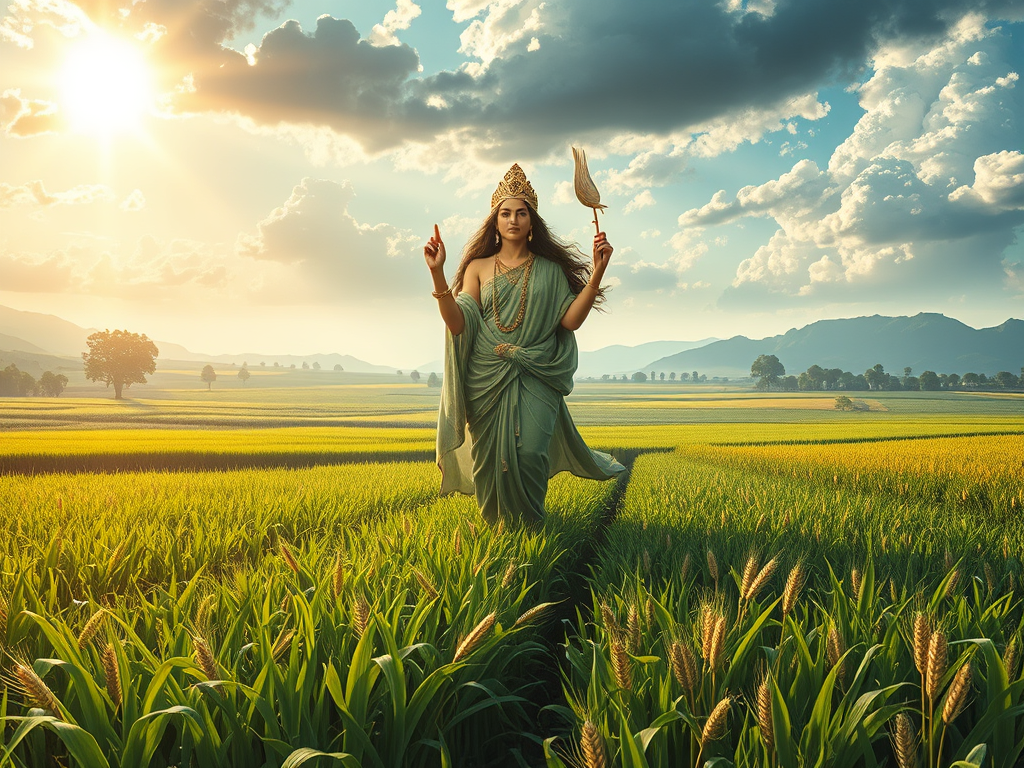
The Rig Veda is the oldest sacred text in India, and probably in all of humanity. It is directly linked to the Seven Rivers Civilization, also known as the Indus-Sarasvati Civilization. This collection of poetic hymns, transmitted orally for centuries, reflects the daily life, beliefs, and practices of the ancient inhabitants of this region. Among the many themes covered, agriculture and the cycles of nature occupy a central place.
In this civilization, agriculture was an essential activity. It depended heavily on the seasons, rain, and the proper functioning of natural cycles. The hymns of the Rig Veda show how this dependence shaped the worldview of the ancients.
1. Seasons as sacred rhythms
Agricultural cycles are based on seasons: the rainy season, the dry season, the return of vegetation, the harvest… These stages punctuated the lives of the inhabitants. The Rig Veda often speaks of these seasons, not in a scientific way, but with poetic images that reflect the importance of each period.
One of the central figures associated with the season of renewal is Ushas , the Dawn. She is described as a young girl who rises each day to awaken the world. Her arrival heralds light, warmth, and the beginning of activity, including agriculture. (Rig Veda I.48)
2. Rains, a blessing expected from the gods
In a semi-arid region like Sarasvati, rain was precious. One of the most celebrated gods in the hymns is Indra , the god of rain and lightning. He is often invoked to « make the waters fall » and defeat the dragon Vritra, who holds back the rivers and the rains (Rig Veda I.32). This mythical struggle reflects an agricultural reality: without rain, there is no harvest.
The arrival of the rains, triggered by Indra, allows the fields to turn green, the seeds to germinate, and the farmers to feed their families. Abundance depended on this divine struggle. The hymns are therefore also prayers for survival.
3. The nourishing earth and the seed cycle
The earth is seen as a mother, Prithivî Mâtâ , Mother Earth. She receives the seed, makes it grow, and gives the harvest. The Rig Veda pays homage to this fertile earth which supports all living beings (Rig Veda 5.84.1).
The hymns also speak of seed, plowing, and harvesting. Words like yava (barley) and dhânyam (grain) are found, which show that these peoples were already cultivating certain cereals. The stages of agriculture are linked to spiritual moments: sowing is a sacred act; harvesting is receiving a gift from the gods.
4. Agricultural rituals and offerings
Agricultural production did not only serve to feed the population. Part of the harvest was offered to the gods in fire rituals, the yajna. Grains, milk, ghee (clarified butter), and even the first harvests were poured into sacred flames in homage to the forces of nature.
Agni , the fire god, received these offerings to pass them on to the other gods (Rig Veda I.1). This link between agriculture and spirituality shows that each cycle, each stage of rural life had a sacred dimension.
5. A life punctuated by nature
The hymns of the Rig Veda reveal a society deeply connected to nature. Each element—rain, light, germination, harvest—was perceived as a divine manifestation. The inhabitants of the Seven Rivers Civilization did not separate material and spiritual life. Working the land, sowing, waiting for rain, and harvesting—all formed part of a single sacred cycle.
Conclusion
The hymns of the Rig Veda are not just religious chants. They are also poetic testimonies of a people living to the rhythm of the seasons, rains, and harvests. Agriculture was not just a means of survival; it was an act of connection with the gods. In the civilization of the seven rivers, agricultural cycles were not only a physical reality, but also a way to remain in harmony with the universe.
 Le Rig Veda
Laisser un commentaire