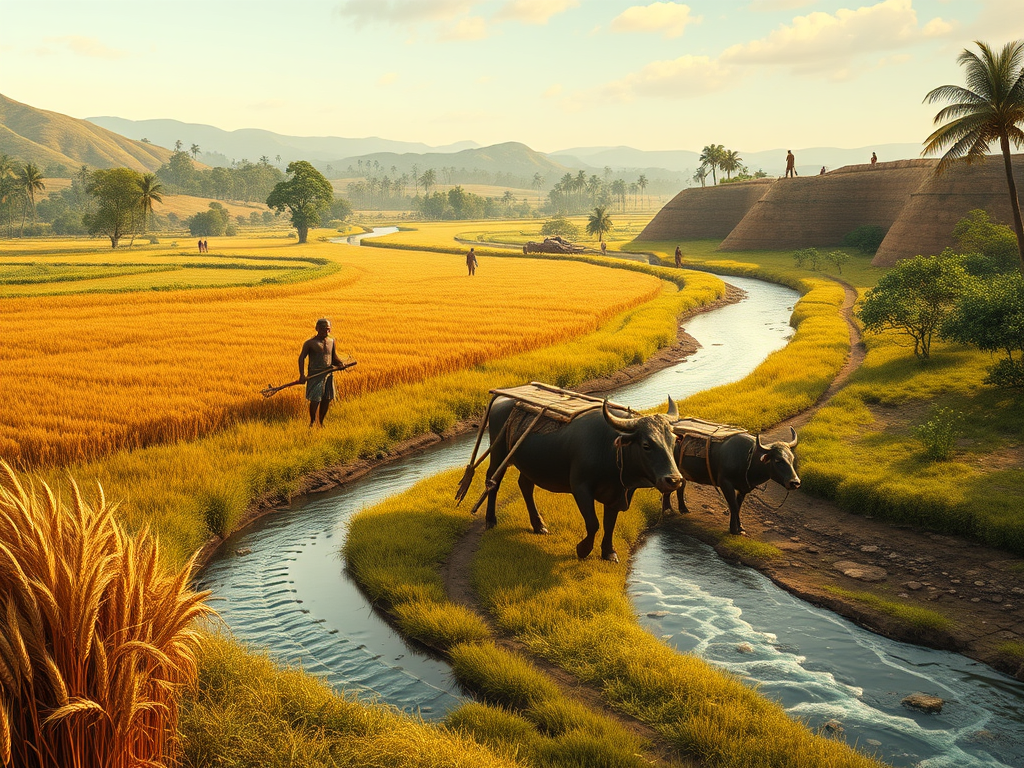
The Seven Rivers Civilization, also known as the Indus-Sarasvati Civilization, developed over 4,000 years ago in a vast region stretching from present-day Pakistan to northwest India. A major river, the Sarasvati, flowed through this region. Although it no longer exists, this river played a vital role in the agricultural development of this civilization.
An environment favorable to agriculture
The Sarasvati Valley enjoyed a wetter climate than today, with seasonal rainfall and fertile land. This allowed the inhabitants to practice agriculture regularly. The silt deposited by floods made the soil rich, ideal for growing crops. Access to fresh water was easy thanks to the numerous wells and canals that dotted the towns and countryside.
The first cultures
The valley’s earliest inhabitants grew wheat, barley, and legumes such as lentils and chickpeas. There is also evidence of cotton, indicating that they already knew how to grow textile crops. These crops were well adapted to the local climate and required little water.
Agricultural tools
Over time, the valley’s farmers improved their tools. Excavations have revealed the use of wooden plows (the ancestor of the plow) pulled by oxen. These tools made it possible to plow the land more easily and more thoroughly. Stone or metal sickles were used to harvest cereals. Millstones were also used to grind the grain.
Irrigation and water management
One of the great advances of this civilization was the establishment of irrigation systems. Canals, dams, and water reservoirs were built to direct water to the fields, especially during the dry season. This expanded cultivable areas and helped feed a larger population. Brick wells, often very deep, were also present in almost every home.
Crop rotation
Archaeological evidence shows that the valley’s inhabitants practiced crop rotation. This method preserves soil quality by changing the type of crop grown from one season to the next. This prevents the soil from becoming depleted and increases harvests over the long term.
Agricultural exchanges with other regions
The Sarasvati Valley did not exist in isolation. Grains and agricultural products were traded with other regions. Products such as sesame, dates, and certain tropical fruits have been found in the cities of the Seven Rivers civilization. This proves that a well-organized trade network existed, also supporting the development of agriculture.
Conclusion
Thanks to good organization, the use of effective techniques, and a close relationship with nature, the inhabitants of the Sarasvati Valley were able to evolve their agriculture. They were able to adapt to the seasons, use water wisely, and make their land prosper for centuries. This agricultural mastery allowed the Seven Rivers civilization to build large cities, enjoy a varied diet, and live in relative comfort.
 Le Rig Veda
Laisser un commentaire