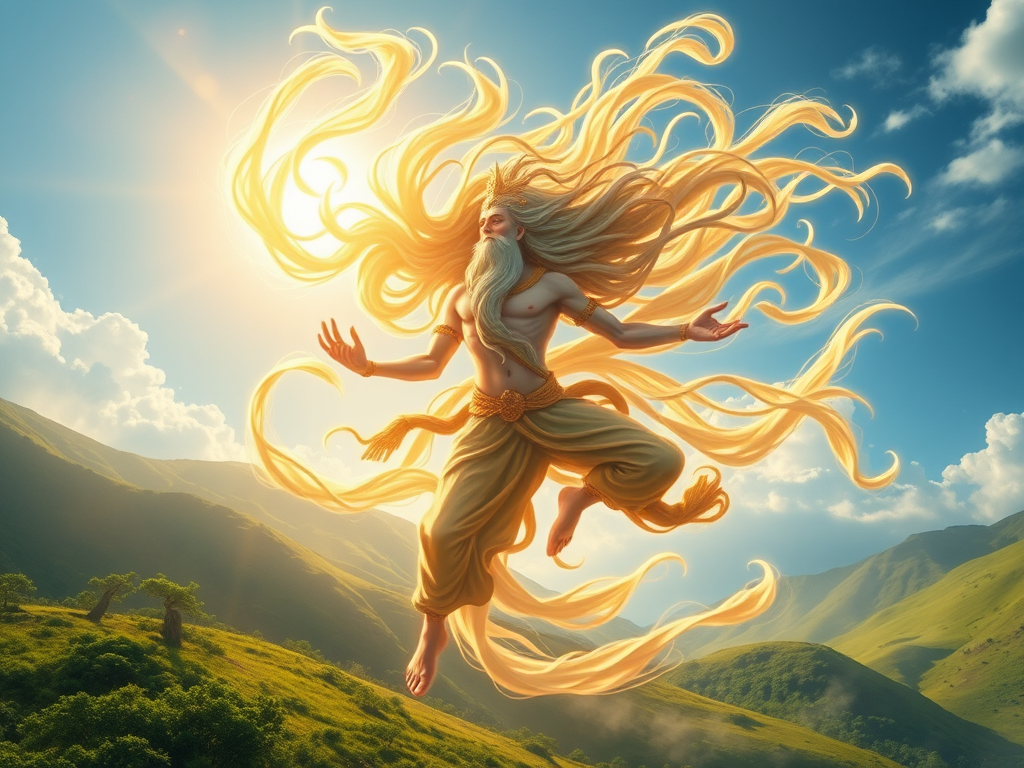
The Rig Veda, India’s oldest sacred text, places great importance on the forces of nature. Among them, the wind holds a special place. It is personified under the name of Vâyu , a deity of breath, movement, freedom, but also of the vital energy that circulates within us.
Who is Vâyu?
In the Rig Veda, Vâyu is both the wind we feel blowing and an invisible divine force. It is linked to the breath of life, what is called prana in Indian traditions. The wind is not simply a natural phenomenon: it is a force that acts in the world and in humanity.
From the very first Mandala (Book I), the wind is honored with respect and joy. Hymn 2 of Mandala I is partially dedicated to it.
Rig Veda I.2 – Hymn to Vâyu :
1 – Vâyu, worthy of being seen, come. The soma juices1 are properly prepared. Drink them, listen to our call.
2 – Vâyu, the invokers call you with recitations2, those who have pressed the soma are the knowers of the Day3.
Here we see a direct, very lively call. The Soma (the sacred drink) is prepared for the wind, as if for an honored guest. There is a relationship of friendship with this force of nature.
A little further on, the anthem continues:
4 – Indra, Vâyu, come near this soma juice with joy, yes, the drops of soma desire you.
5 – Vâyu and Indra, excellent heroes, connoisseurs of soma juices, come both here quickly.
6 – Vâyu and Indra, come, near the pressers who have prepared the soma, thus quickly, O Hero4, by thought.
The wind: free, fast, pure
In other hymns, the wind is associated with speed, freedom, and purity. It crosses the sky unhindered, elusive, and always in motion. The Rig Veda celebrates this quality:
« The wind rushes forth, unhindered, free in space,
it shakes everything that exists. »
This incessant movement is seen as a cosmic force: it sets the world in motion, it makes life circulate. In the Veda, nothing is fixed. Everything breathes, everything vibrates.
Vâyu and the other gods
Vâyu is never alone. He is often invoked with Indra , the god of strength and will. Together, they represent action, momentum, and conquest. One brings breath, the other power.
But Vâyu is also linked to Prana , the inner breath. This is a very profound idea: the same wind that blows in the sky also blows within us.
Conclusion
The hymns to Vâyu in the Rig Veda are full of simple yet powerful images. They show how the ancient sages saw nature as alive and sacred. The wind was not a mere phenomenon: it was a god, a breath, a presence.
Even today, when we read these ancient songs, we feel a little of that breath. It reminds us that life is movement, freedom, energy.
1Drink containing milk and psilocybes.
2Of mantras.
3Light, illumination.
4Spiritual, of course.
 Le Rig Veda
Laisser un commentaire