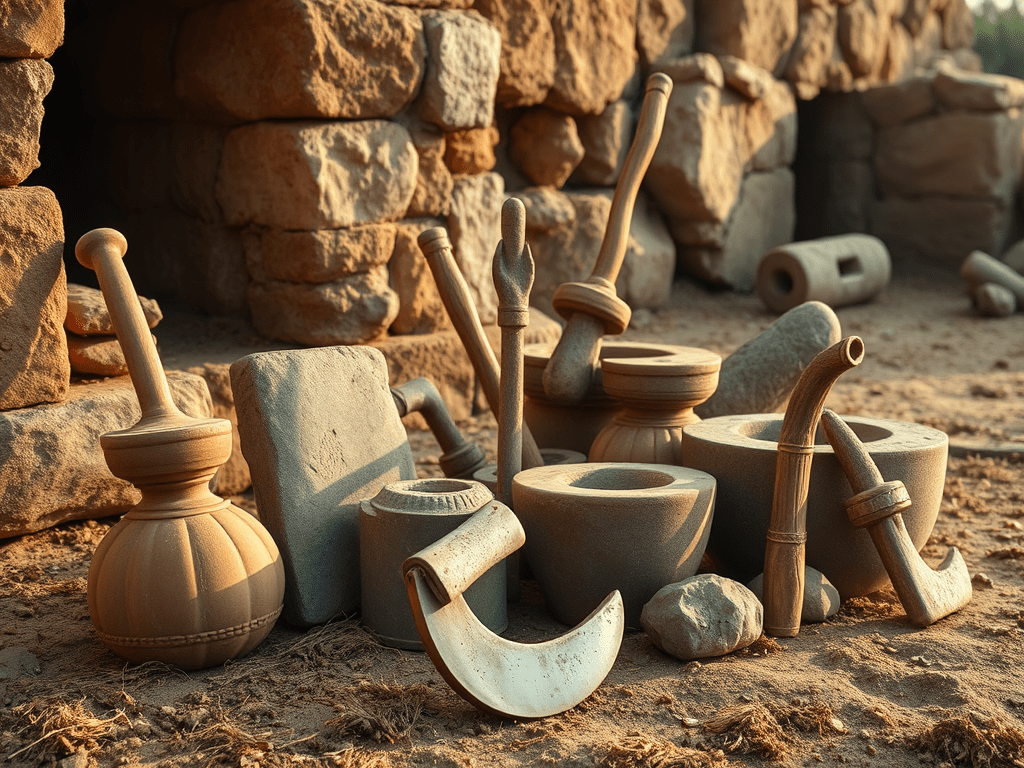
Kalibangan, one of the major cities of the Seven Rivers Civilization, has revealed many clues about the agricultural practices of this era. Archaeological excavations have uncovered several tools, showing how the inhabitants cultivated the land and developed their techniques to improve their harvests.
Agricultural tools discovered
Archaeologists have unearthed various tools made of terracotta, copper, and stone. Among the main ones:
- Clay plows : These are the most striking remains. They indicate that the inhabitants of Kalibangan were already using an advanced plowing system. Some furrow prints found on the ground suggest organized agriculture.
- Copper sickles : These sickles were used to harvest grains such as barley and wheat, two main crops in the region.
- Stone axes and hoes : These were used to prepare the soil and cut plants.
- Millstones : These tools were used to grind grains into flour.
The evolution of agricultural techniques
The study of agricultural tools shows an evolution towards more efficient agriculture:
- A structured tillage system : The presence of ploughs proves that Kalibangan farmers did not just broadcast seed, but also made furrows to optimise plant growth.
- Use of copper : Compared to stone, copper was more efficient for making sickles and cutting tools, making harvesting easier.
- Crop rotation : Imprints on the soil suggest that farmers rotated between different crops to avoid soil depletion.
- Irrigation : Even though Kalibangan was close to the Sarasvati, the gradual drying up of the river probably pushed the inhabitants to dig canals to irrigate their fields.
Know-how ahead of its time
The inhabitants of Kalibangan mastered techniques that went beyond simple subsistence farming. Organized plowing, the use of copper, and adaptation to climatic conditions demonstrate their ability to adapt and optimize their harvests. These tools and methods influenced the agriculture of subsequent generations.
Analyzing these remains helps us better understand how the Seven Rivers civilization prospered thanks to well-organized and efficient agriculture.
 Le Rig Veda
Laisser un commentaire