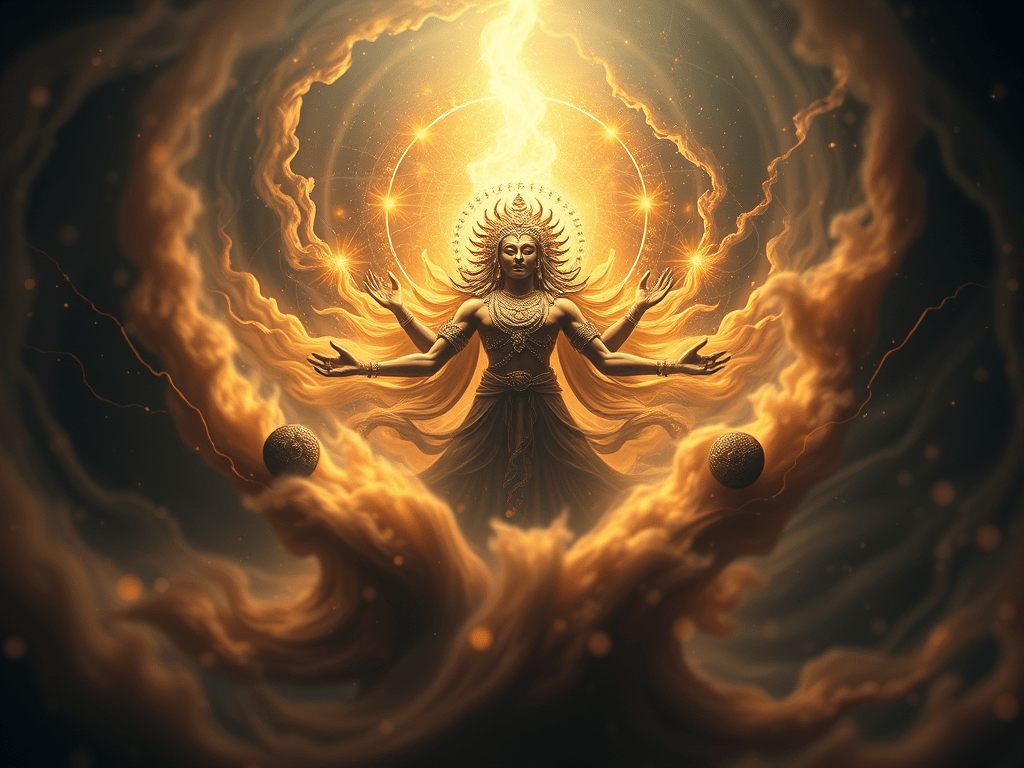
The Rig Veda , India’s oldest sacred text, contains several hymns that explore the creation of the world and the first living beings. These narratives, often symbolic and poetic, do not present a single cosmogony but several complementary visions of the emergence of life and the universe.
1. The Hymn of Creation (Nasadiya Sukta)
One of the most famous hymns on creation is the Nasadiya Sukta (Rig Veda 10.129). This text evokes a time before the world existed, when neither being nor non-being existed , and darkness and undifferentiation reigned. It suggests that creation began with a primordial breath (prāna) and a cosmic force that impelled existence.
The text is notable for its skeptical conclusion: » 7 – How did this creation come about? Was it realized or was it not? He who, in the farthest Heaven, observes this world surely knows. And what if he did not know? » This shows a philosophical openness to the nature of the beginning of the universe and of life.
2. Purusha, the Cosmic Being
Another fundamental story is that of the Purusha Sukta (Rig Veda 10.90). It describes the creation from the Purusha , a primordial cosmic being who was sacrificed by the gods to give birth to the universe. From his body were born:
- The Brahman (the universal)
- The human castes : the face became the priests (Brahmins), the arms the warriors (Kshatriyas), the thighs the merchants (Vaishyas), and the feet the servants (Shudras).
- The physical world , including the earth, sky, and stars.
This story puts forward the idea that the universe and life are the product of a primordial sacrifice , a fundamental concept of Vedism.
3. Hiranyagarbha, the Golden Branch
The Hiranyagarbha Sukta (Rig Veda 10.121) introduces another image of creation: that of the GermGolden Egg (Hiranyagarbha). This is a cosmic germ floating on the primordial waters, from which Prajapati , the Lord of creation, was born. This myth is comparable to other world cosmogonic stories, such as the Primordial Egg in Egypt and Greece.
Prajapati is considered the procreator of the first living beings , organizing chaos to form the cosmos and breathe life.
4. The emergence of the first living beings
The Vedic hymns evoke several entities that mark the appearance of life:
- Agni (fire) : Primordial divine emanation, it symbolizes vital energy and transformation.
- Soma (the sacred drink) : Associated with enlightenment, it is seen as a force enabling the connection between the divine world and humans.
- Varuna and Mitra : Guardians of the cosmos, they watch over the universal order and the cycle of life.
- The Maruts : Celestial beings linked to storms and winds, expressing the agitation of elemental forces.
These elements show that in the Rig Veda, life is not born from a single act, but from a structured cosmic process , where natural and divine forces participate in the establishment of the universe.
Conclusion
The Rig Veda does not offer a single explanation for the creation of the first living beings, but a plural and symbolic vision of the origin of life. Whether through the primordial breath , the sacrifice of the Purusha , the hatching of the Golden Seed or the action of the gods, these stories show a profound reflection on the relationship between the universe, the elements and life.
These myths continue to influence Indian and spiritual thought, illustrating a cosmogony where creation is at once a mystery , a divine act , and an orderly natural process .
 Le Rig Veda
Laisser un commentaire