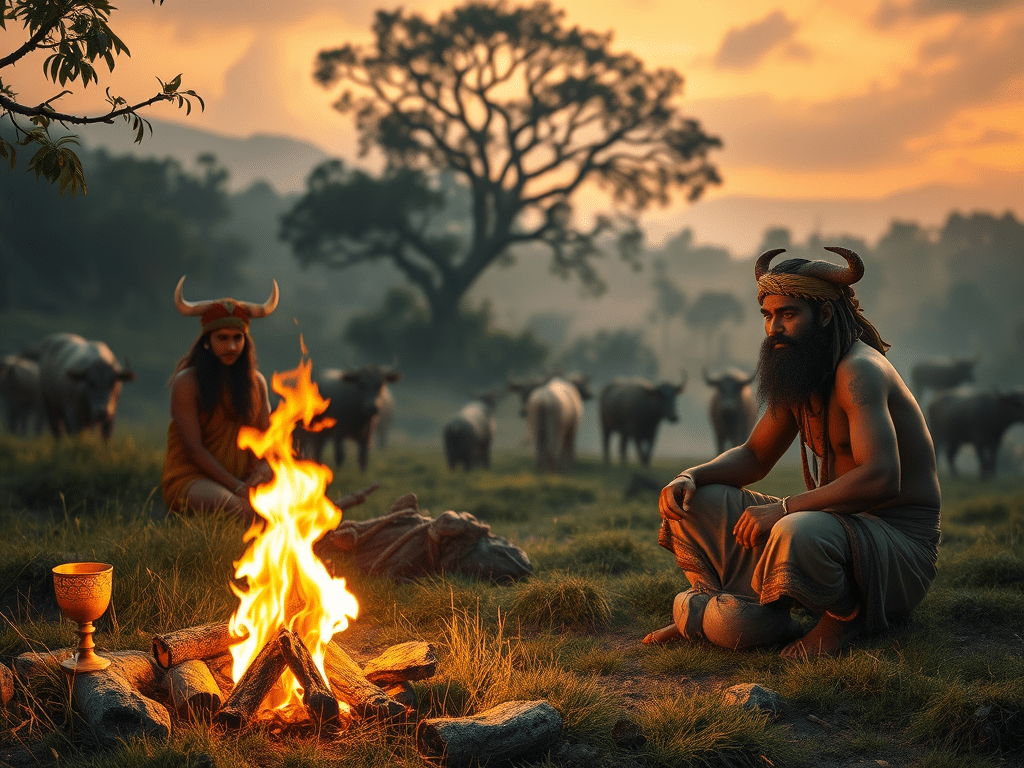
The hymns of the Rig Veda, considered the oldest body of literature known to mankind, offer a unique window into a time long before the emergence of the great cities of the Seven Rivers civilization, known as the Indus-Sarasvati civilization. In particular, mandalas 2, 3, 4, 5, 6, and 7 are often considered the oldest and relate significant events of this pre-urban era. These texts describe a world where human communities were organized around clans living in harmony with nature and confronted with mythical and real struggles.
A Clan and Pastoral Society
The Vedic hymns depict a society based on animal husbandry and agriculture, with a strong dependence on natural forces. Clans are depicted as autonomous social units, led by charismatic leaders (“rājas”). The role of the sacred is central to daily life, with rituals intended to appease the gods and ensure prosperity. The sacred fire (“Agni”) and the mystical drink Soma play a prominent role in these practices.
The descriptions in the hymns show an economy based on cattle breeding, which was not only a source of subsistence but also a unit of wealth and a stake in conflict. Vedic terms such as “go” (cow) appear frequently and emphasize the importance of this livestock in exchanges and ritual offerings.
The Mandalas of the Rig Veda and their Contexts
Mandalas 2 to 7: Chronicles of the Pre-Urban Age
Mandalas 2, 3, 4, 5, 6 and 7 are considered the oldest and tell of major events from a time before the urban phase. They relate mythological and historical struggles such as:
- The Legend of Vṛitra : Indra, the warrior god, kills the dragon Vṛitra to release the waters. This episode probably symbolizes a drought caused by a super-volcano that darkened the sky, about 7300 years ago.
- Conflicts with Shushna and Shambara : These enemies, often depicted as leaders of other clans or tribes, illustrate tensions between groups for control of resources. Shushna symbolizes a great drought that probably occurred 8,200 years ago during the great general cooling of the northern hemisphere.
- The War of the Ten Kings : This epic event, described in Mandala 7, shows a coalition of tribes confronting King Sudas, reflecting the alliances and rivalries of the time.
The First Mandala: A Varied Compilation
Although it contains very ancient hymns, the first mandala also includes compositions from various periods. It reflects a synthesis of oral traditions transmitted over several generations.
The Eighth Mandala: Transition to Urbanization
Probably dating from the beginning of the urban phase, around 5500 years ago, this mandala shows changes in practices and mentalities. The hymns reflect a changing society, with elements that prefigure urban organization.
The Ninth Mandala: The Soma as the Central Axis
Entirely devoted to Soma, this mandala brings together hymns from all eras and families of rishis. Its compilation probably dates back to before 2200 BC, the date of the great drought which would have marked the disappearance of the original Soma, often identified as Psilocybe cubensis.
The Tenth Mandala: An End of Cycle
Composed around 2000 BCE, this mandala reflects the last moments of classical Vedic civilization. The rishis responsible for these hymns belong to a new generation, with some exceptions linked to ancient lineages. This text testifies to social and spiritual changes after the disappearance of the original Soma.
Conclusion
The Vedic hymns of the various mandalas offer an evolving narrative of a society in transition, moving from a pastoral and clan way of life to a pre-urban and then urban organization. These texts are as much mythological archives as historical reflections, allowing us to understand the cultural and economic changes that preceded the emergence of the great cities of the Indus-Sarasvati valley. Their study continues to reveal the deep roots of Indian civilization.
 Le Rig Veda
Laisser un commentaire