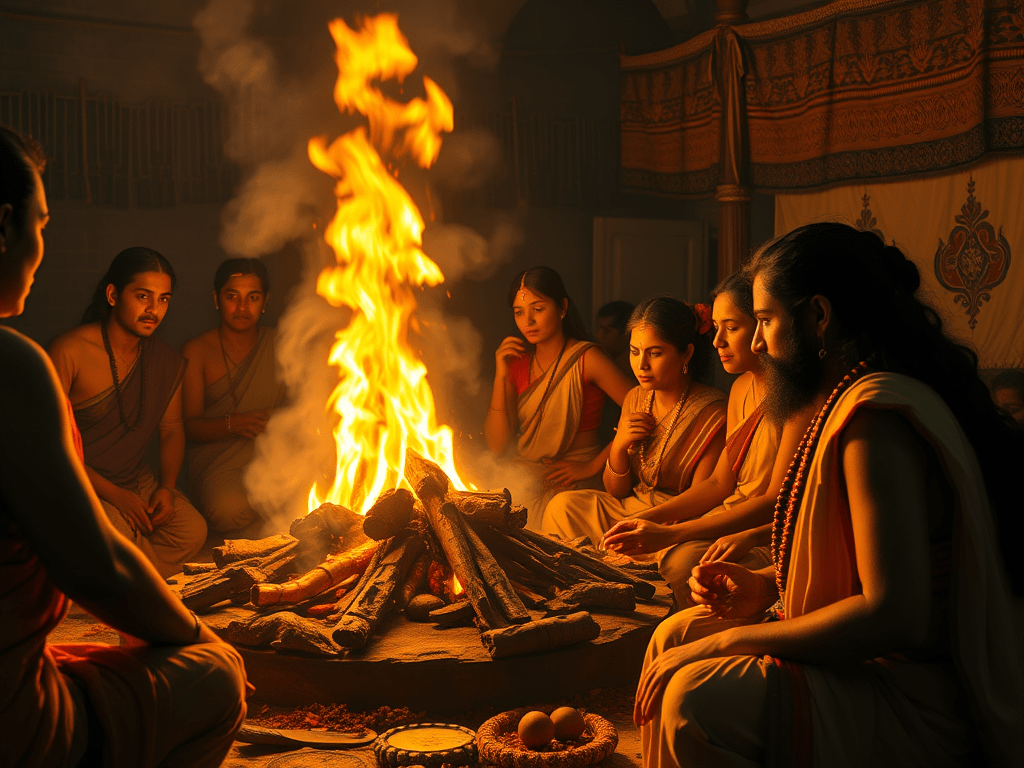
Funeral ceremonies and hymns on death in the Rig Veda are essential aspects of understanding the beliefs and practices of the Seven Rivers Civilization. These traditions, which date back over 5,500 years, reveal a spiritual and philosophical approach to death and the afterlife. Archaeological sites such as the cemeteries of Harappa and Rakhigarhi provide tangible evidence of these ancient practices. The Rig Veda, the first of the four Vedas, contains several hymns and passages that express rituals, prayers and thoughts on death.
Funeral rites
The funeral rites of this civilization reflect a cosmic vision where death is considered as a transition to another state of existence. Funerals could take two main forms: cremation or burial. These rites were often accompanied by sacred songs that guided the soul of the deceased. They aimed to ensure that the soul accessed a spiritual realm called the « world of ancestors », where it would join the beings who had already departed.
Hymns about death
The most frequently cited hymn on death in the Rig Veda is 10.14, which invokes Yama, the first mortal to cross the passage to the afterlife and thus become the god of the dead. Yama is presented as a benevolent guide who welcomes souls and shows them the way. This hymn calls for the protection of the deceased by divine forces and for the safety of body and soul during the journey.
The evolution of funeral beliefs
It is important to note that hymns on the afterlife do not appear until the tenth mandala of the Rig Veda, written much later than the others, around 2100 BCE. This period corresponds to the one that followed the disappearance of the soma, largely due to the drought that affected the region. Before this, rituals focused more on purification and cosmic continuity than on the afterlife.
The role of Agni
Funeral hymns often emphasize the importance of purification and cremation. The flame of the sacred fire, Agni, plays a central role as a messenger between the world of the living and the dead. Agni is implored to carry the soul to the heavenly realms, ensuring that it experiences no harm or suffering. Families prayed for the deceased to be reunited with the ancestors and to be granted eternal peace.
The Cosmic Vision of Death
Death in the Rig Veda is often seen as a return to the cosmic universe. The hymns express the idea that each individual is a part of the greater whole, and that upon death, he or she returns to the fundamental elements of nature. This reflects a holistic view where body and mind are never totally separate from the cosmos.
Hymns of consolation
Finally, hymns of consolation aim to bring comfort to loved ones. They often express the idea that life and death are equally natural parts of existence. The hope of rebirth, regeneration, and eternity is sometimes evoked, thus helping the living to accept loss and find inner peace.
These funerary traditions and hymns show how the 7 Rivers civilization approached death not as an end, but as a transformation. This philosophical and spiritual view of life and the afterlife is one of the keys to understanding their culture and their age-old wisdom.
 Le Rig Veda
Laisser un commentaire