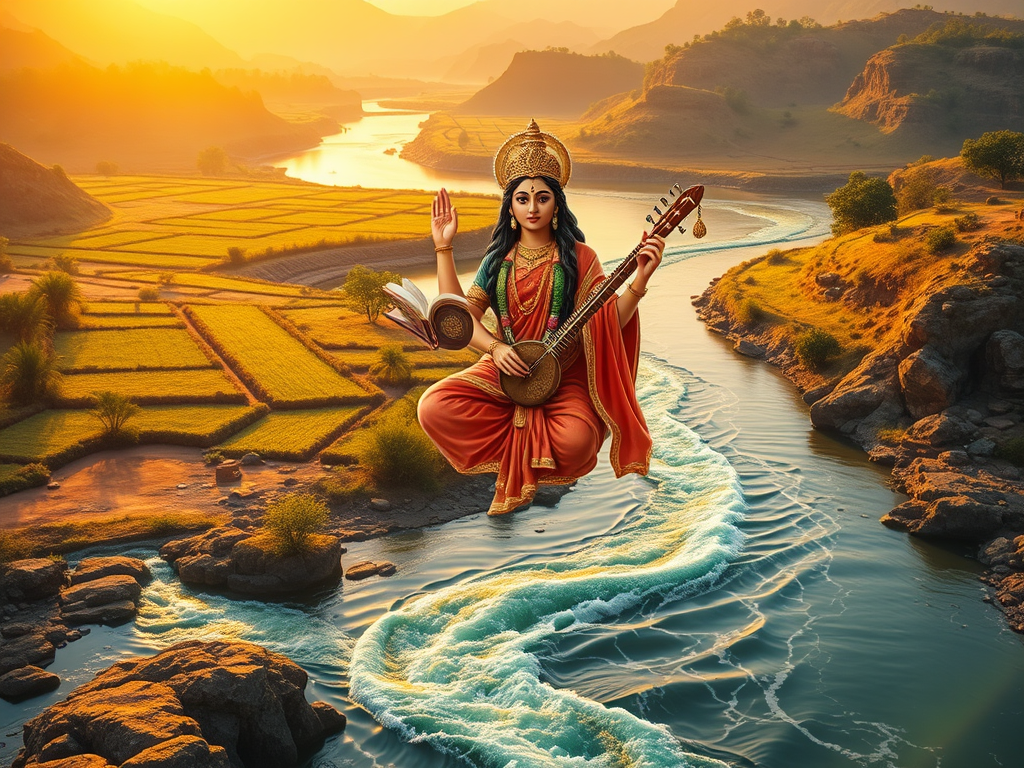
The Sarasvati is one of the most revered rivers in ancient Indian texts, both as an actual river and as a divine goddess. In the civilization of the seven rivers, it played a central role as the axis of life for the communities that lived on its banks. The Purus, a confederation of Vedic peoples including the famous Bharatas, inhabited both banks of this river. Their culture, deeply spiritual and advanced, developed around the sacred waters of the Sarasvati.
A river that nourished civilization
The Sarasvati River flowed through a region now known as the Indus-Sarasvati Valley. It provided abundant water for agriculture, domestic needs, and religious rituals. The people of this region built elaborate irrigation and water management systems, allowing their civilization to flourish.
The Purus considered this river to be the source of all life. The hymns of the Rig Veda, the oldest sacred text of humanity, praise the Sarasvati for its power, abundance and connection with the divine. The river was not only a natural resource, but also a symbol of purity, knowledge and prosperity.
The Transition to Classical Vedic Civilization
Around 2000 BC, a major earthquake changed the geography of the region. Two of the Sarasvati’s main tributaries, the Yamuna which flowed into the Drishadvati and the Sutlej, changed course, significantly reducing the flow of the river. Gradually, the Sarasvati dried up, forcing the inhabitants to migrate to other regions, particularly the Ganges valley.
This change marked the end of the civilization of the seven rivers. However, the Purus and the Bharatas continued to transmit their culture and beliefs, giving rise to what is known as the classical Vedic civilization. Epic tales such as the Mahabharata preserve traces of this historical transformation.
Sarasvati in sacred texts
Even after her drying up, Sarasvati remained a powerful symbol. In Vedic texts and Hindu traditions, she is honored as the goddess of wisdom, art, and knowledge. She is often depicted holding a book and a veena, symbolizing knowledge and music.
Legacy of Sarasvati
The memory of Sarasvati and the civilization of the seven rivers continues to inspire historians and researchers. This legendary river is not only a key element of ancient Indian history, but also an example of how people adapted to environmental challenges while preserving their culture.
The Sarasvati, both river and goddess, remains a cultural and spiritual pillar, connecting a vanished civilization to the deep roots of the Vedic heritage.
 Le Rig Veda
Laisser un commentaire