The Rig Veda, the oldest sacred text in India, is a pillar of Indian spiritual and philosophical culture. Composed of songs dedicated to the gods and natural forces, it reveals the deep relationship of Vedic man with the cosmos. However, the centuries that followed saw the evolution of Indian spiritual and philosophical practices, influenced in particular by the shortage of Soma around 2200 BCE. This sacred entheogenic plant, allowing connection to the gods and altered states of consciousness, played a central role in Vedic rituals. With its scarcity, the sages (rishis) explored new natural paths to achieve enlightenment, thus marking the turning point towards the practices of yoga and the philosophy of Bhakti.
The Impact of Soma Shortage: A Transition to Natural Techniques
Soma, consumed during rituals, offered a direct mystical experience, like a bridge to the divine. The disappearance of this plant (or its scarcity) encouraged the rishis to look for alternatives. Far from limiting themselves to simple ritual practices, they turned to the Upanishads, which introduced practices of meditation and introspection aimed at reaching the transcendental state of consciousness without external substances. This change symbolizes the transition to natural techniques such as pranayama (breath control), meditation and yoga postures, which we still find in modern spiritual philosophies.
The Upanishads deepen the concepts already present in the Rig Veda but orient them towards an inner quest, moving the divine experience from the external to the internal. The spirit of personal research, in search of inner realization without Soma, reinforced the development of spiritual practices based on self-discipline and self-observation. Thus, Vedic philosophy evolved towards more personalized and introspective practices, favoring spiritual disciplines.
The Roots of Yoga and Bhakti: Practices Established in the Vedic Tradition
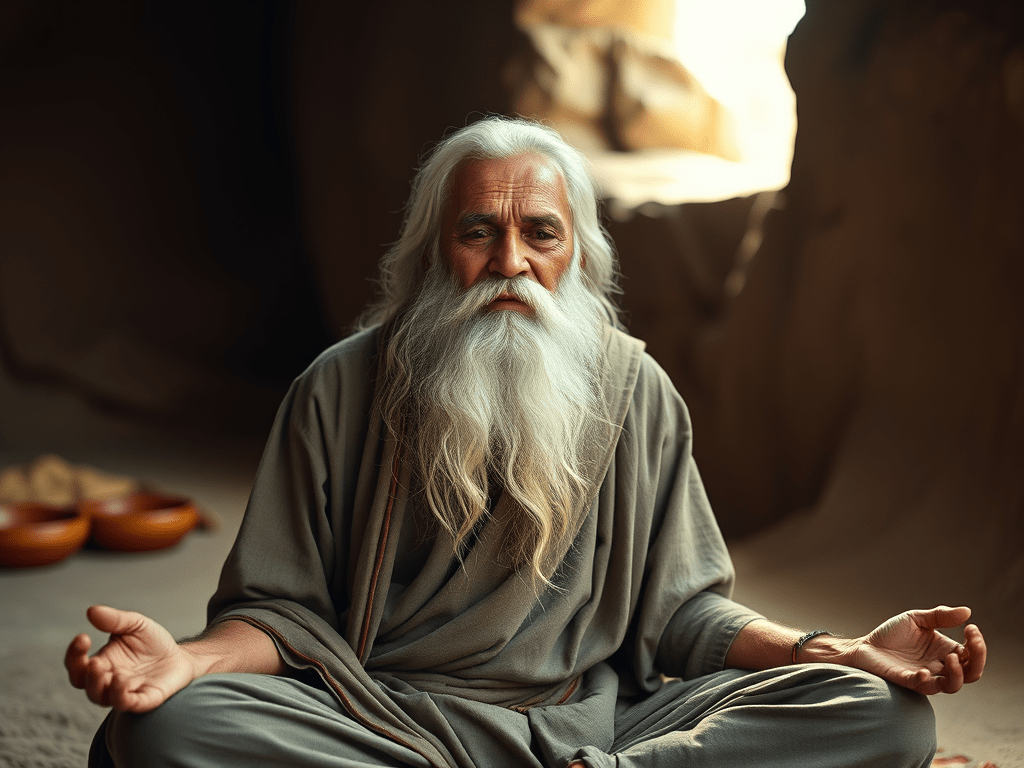
The origin of yoga in the Vedic civilization is attested by seals found in the Indus Valley and Sarasvati, depicting figures in meditation positions similar to the yogic postures (asana) known today. The Rig Veda mentions the term yuj, meaning « to unite » or « to join », which would later become the basis of the concept of yoga, associating the mind and body in a single effort of spiritual purification.
After the dearth of Soma, yoga evolved into a discipline for reaching the elevated states of consciousness once facilitated by the sacred plant. With the introduction of practices such as asana and pranayama, yoga became a path to union with the divine through mastery of body and mind, emphasizing a direct connection between the self and the universe without the need for substances.
Bhakti, or devotion, also gained momentum during this period. Although its roots go back to the hymns of the Rig Veda dedicated to the deities, the philosophy of Bhakti developed with a more personal and emotional dimension. Devotion allowed one to experience the divine through inner surrender, without Soma, relying solely on emotional intensity and spiritual connection. Bhakti would become a major movement, particularly in texts such as the Mahabharata and the Bhagavad Gita, which encouraged an intimate and devoted relationship with the divine.
Philosophical Heritage and Lasting Influence
The transition from the Vedic period to the Upanishads thus gave rise to a rich array of spiritual practices and philosophies, marked by naturalness and inner discipline. The Rig Veda, as a founding text, offers the first traces of this quest for cosmic union, but it was the dearth of Soma that catalyzed the search for techniques of lasting spiritual transformation, anchored in practices accessible to all.
This legacy is still evident in contemporary Indian philosophy, where yoga and Bhakti remain pillars of spirituality. The wisdom of the Rig Veda, supported by the discipline of yoga and the devotion of Bhakti, continues to inspire a holistic vision of enlightenment and spiritual well-being.
 Le Rig Veda
Laisser un commentaire