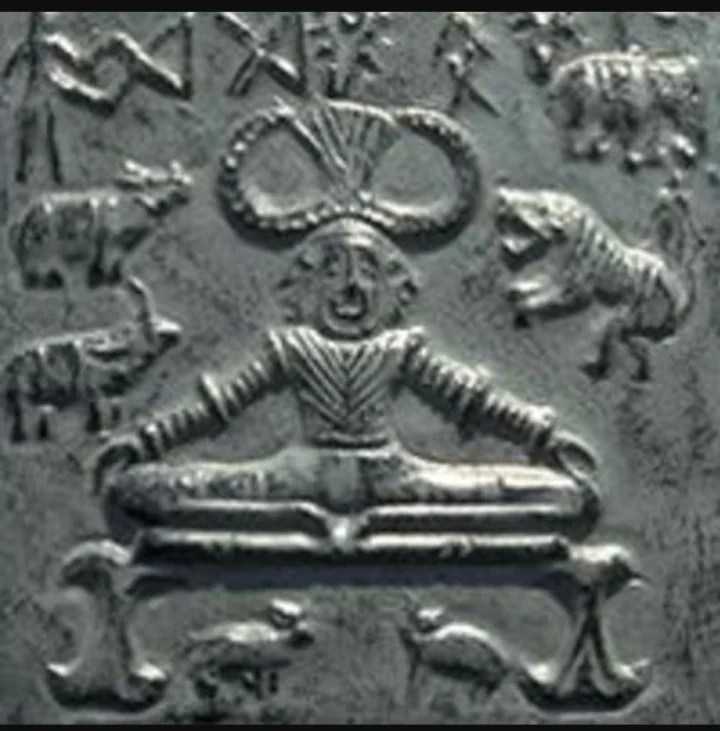
Asceticism in India is a millenary tradition that has endured through the ages. Even today, ascetics, called sadhus, lead a life of renunciation and discipline to attain higher states of consciousness. Their goal is to free themselves from material attachments and elevate their minds to the infinite.
Ancient Origins: The Seals of the 7 Rivers civilization
Although we do not have direct evidence of asceticism in the Seven Rivers civilization, there are some interesting clues. Archaeologists have discovered seals in Mohenjo-Daro and other cities, depicting figures seated in yogic postures, with the soles of their feet together, suggesting that meditative and spiritual practices were already present at that time. This suggests that the inner quest and control of the body for the expansion of consciousness was already practiced in this ancient civilization.
Renunciation of the World in Present-Day India
Today, sadhus continue to renounce all material comforts to devote themselves to the spiritual life. They abandon their homes, their families, and often live in caves, forests or temples. They seek freedom from earthly desires, believing that it is by detaching themselves from the material world that they can attain higher states of consciousness.
Some of them adopt extreme practices, such as remaining in a single posture for hours, fasting for extended periods, or even voluntarily submitting themselves to the rigors of nature without shelter or clothing.
Fasting and Meditation
Fasting is another central practice of asceticism. By depriving themselves of food and water, ascetics weaken their bodies to strengthen their minds. This allows them to focus entirely on meditation, which is at the heart of their spiritual quest.
Meditation, accompanied by pranayama (breath control), helps them to calm their minds and enter states of deep consciousness. Some sadhus achieve mystical experiences or visions, which they interpret as signs of progress towards enlightenment.
Asceticism as a Path to Liberation
The ultimate goal of asceticism is to attain moksha, liberation from the cycle of rebirth. By transcending their ego and renouncing worldly desires, sadhus hope to merge into cosmic unity and attain enlightenment.
—
Ascetic practices, still visible in present-day India, seem to have deep roots, potentially linked to the Seven Rivers Civilization. The seals of the Seven Rivers Civilization are one of the earliest testimonies of this spiritual quest, showing that meditation and the expansion of consciousness were already part of their way of life.
 Le Rig Veda
Laisser un commentaire