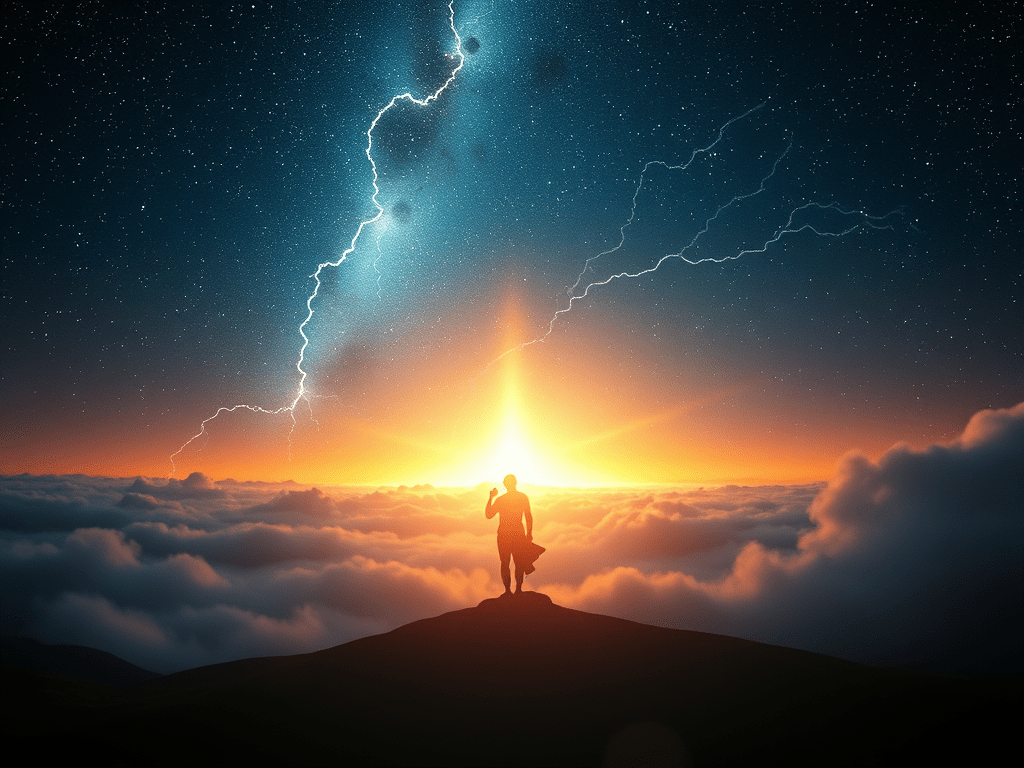
The Rig Veda, the oldest sacred text of humanity, is a hymn dedicated to the gods who symbolize natural forces and cosmic principles. These Vedic deities are not only mythological figures, but representations of natural energies, elements and universal laws that govern the world and human beings. Contrary to classical interpretations that often reduce them to purely anthropomorphic divinities, these gods embody profound forces existing in nature and in ourselves.
Aditi : The Infinite and the Universal Mother
Aditi means « unbound », the infinite. She is the Mother of all things, the Mother Goddess. Aditi symbolizes unity, the limitless expanse of the cosmos, and the matrix that encompasses all creation. She signifies freedom and immensity, her role transcends that of a simple earth deity. Aditi is the origin of the universe, the primordial creative force.
Agni : The Sacred Fire and Illumination
Agni, the sacred fire, occupies a central place in Vedic rituals. As a divine messenger, he is the intermediary between men and the gods, because the offerings poured into the fire are sent directly to them. But beyond his ritual role, Agni is also the light that drives away darkness, both on the physical and spiritual levels. He is the embodiment of Illumination, of knowledge that dispels ignorance.
The Ashvins : The Luminous Twins
The Ashvins, whose name means « horse-like, » are twin gods associated with the dawn. They are brothers of the Aurora (Ushas) and embody the rising of the sun, symbolizing renewal and inner illumination. The Ashvins are also healers, intervening to restore physical and spiritual harmony. Their association with the twin stars Castor and Pollux strengthens their connection to the light that precedes dawn.
Indra : The Power of Storm and Intellect
Indra, whose name means « mighty, » is the king of the gods and the master of storms. He is the celestial warrior, armed with lightning, who fights the dark forces to bring light to humanity. Indra is also associated with the senses and the intellect, a sense recognized in India. His connection with the soma strengthens his ability to awaken human consciousness. Through his victories, he conquers light (symbolized by the cow) and the life force (the horse), essential symbols of spiritual ascension.
The Maruts : The Furious Winds
The Maruts, sons of Rudra, are deified furious winds, bearers of storms and energy. Their name means « who cause death », because they embody the destructive power of storms, but also the vital force and the energy that regenerates. Companions of Indra, they represent the will and the energy necessary to overcome obstacles.
Mitra and Varuna : Friendship and Cosmic Order
Mitra and Varuna form an inseparable duo in the Rig Veda. Mitra, whose name means « friend, » embodies daylight, warmth, and benevolence. He is the lord of love and harmony. Varuna, on the other hand, is « that which surrounds, » the sky and the ocean. He is the guarantor of cosmic order and truth, the one who watches over the laws of the universe. Together, they balance the forces of love and justice.
Rudra : The Saving Destruction
Rudra, « the one who makes weep », is an ancient form of Shiva. He represents both destruction and compassion. His anger devastates, but it is to make way for light. He embodies the force necessary to destroy ignorance and allow the light of knowledge to emerge.
Sarasvati : The River of Knowledge
Sarasvati, goddess of the famous river, is the personification of the flow of divine speech and knowledge. She symbolizes the inspiring force that illuminates thought and meditations. It is through her spiritual current that the first poets and sages found inspiration to compose the Vedic hymns.
Soma : The Divine Nectar
Soma is both an entheogenic plant, its juice, and a divinity. This sacred drink allows one to reach spiritual enlightenment, a higher state of consciousness. Consumed during rituals, soma is a symbol of inner transformation, which frees man from material limitations to access the absolute.
Sûrya and Ushas : The Sun and the Dawn
Surya is the Sun God, the source of all light and truth. He embodies supreme illumination, the clear vision of reality. Ushas, the dawn, symbolizes the awakening of consciousness, Illumination. Together, they represent the constant cycle of spiritual awakening, each day being a new opportunity to seek the inner light.
Vâyu : The Breath of Life
Vâyu is the deified wind, the breath that animates all things. As master of the intermediate world, he represents prana, the vital energy that circulates in the body and the universe. Vâyu is the force that connects gods and men, and that sustains all life.
Vishnu : The Protector of Cosmic Order
Vishnu is the one who « is active », guarantor of the proper functioning of the cosmos. He helps man in his spiritual journey, providing him with the stability and strength necessary to overcome trials. He is the incarnation of divine activity, that which maintains harmony in the universe.
Conclusion
The gods of the Rig Veda are much more than mythological figures. They embody the natural and spiritual forces that govern the universe and man. Through their varied roles, they symbolize spiritual awakening, enlightenment and the aspiration for an existence in harmony with cosmic laws. These divinities, in perpetual interaction with the world of men, remind us of the importance of integrating the forces of nature and the universe into our inner quest.


Laisser un commentaire