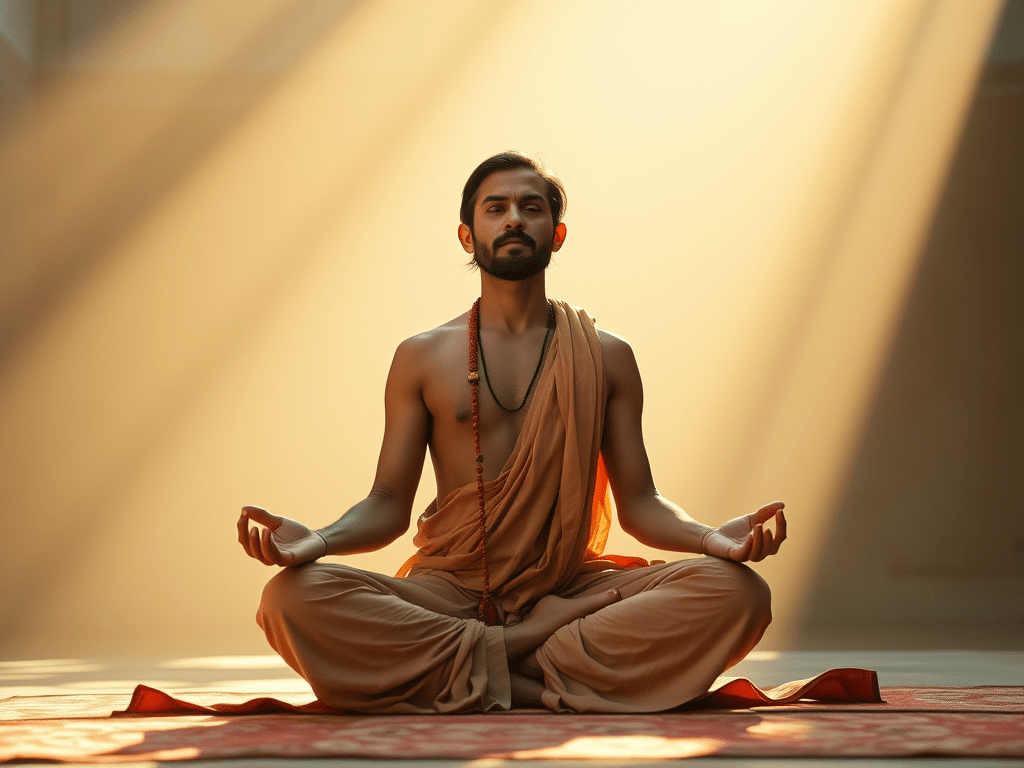
Raja Yoga, often called the « royal path, » is one of the four main paths of yoga in the Indian tradition, focusing on mastering the mind through meditation. Unlike other forms of yoga that focus on physical or devotional practices, Raja Yoga emphasizes the exploration and purification of the mind.
1. The foundations of Raja Yoga
The term « Râja » means « royal, » indicating that this path leads directly to the experience of pure consciousness. Râja Yoga is based primarily on the Yoga Sutras of Patanjali, a classical text that offers a set of practices to discipline the body and mind.
The method of Raja Yoga is based on Ashtanga Yoga, or the eight limbs, which are:
– Yama (ethical principles)
– Niyama (personal disciplines)
– Asana (postures)
– Pranayama (breath control)
– Pratyahara (withdrawal of the senses)
– Dharana (concentration)
– Dhyana (meditation)
– Samadhi (union with the divine)
2. The practice of deep meditation
The heart of Raja Yoga is found in the last three limbs: Dharana, Dhyana and Samadhi. Through concentration (Dharana), the mind is guided to a single point, which stabilizes the thoughts. This evolves into meditation (Dhyana), where the practitioner enters a state of uninterrupted contemplation. Finally, complete union, or Samadhi, is achieved when the individual transcends the ego and experiences universal consciousness.
3. Mind control
In Raja Yoga, the mind is compared to a lake. Thoughts are like waves that disturb the surface. The goal is to calm these waves until the lake becomes still. This serenity allows one to see beyond the surface and perceive the deeper nature of reality. This requires daily discipline, because the mind, by nature, tends to wander.
4. A gradual approach
The path of Raja Yoga is methodical and progressive. The practice often begins with the Yamas and Niyamas, which establish a moral and ethical foundation. Then, asanas and pranayama help to stabilize the body and energy. Once this is mastered, the practitioner can begin to cultivate the art of sensory withdrawal, to gradually enter states of concentration and meditation.
5. The benefits of Raja Yoga
One of the main benefits of Raja Yoga is greater self-control. By learning to calm the thoughts and discipline the mind, the practitioner develops mental clarity and inner peace. Over time, this practice allows one to better understand the workings of the mind, and to rise above the daily emotional fluctuations.
In conclusion, Raja Yoga is a demanding but liberating path, which leads to a deep knowledge of oneself and of reality. It is a path which, although subtle, opens the door to true inner freedom.
 Le Rig Veda
Laisser un commentaire