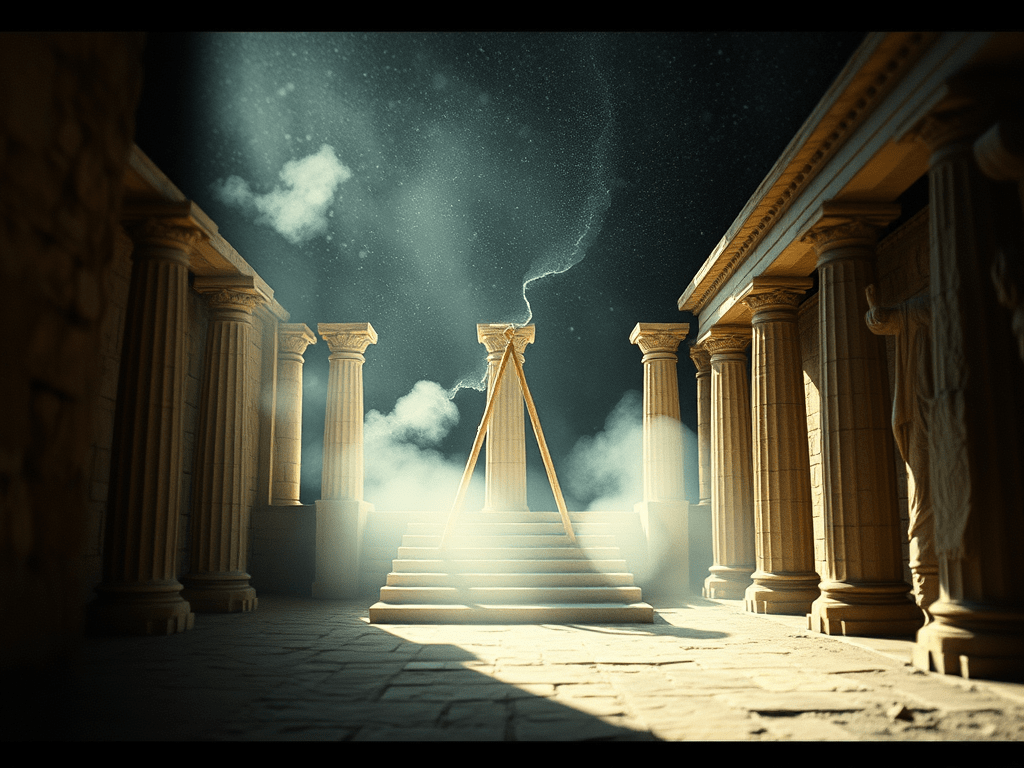
The Oracles of Delphi are one of the most fascinating phenomena of Greek antiquity. Located at the foot of Mount Parnassus, the sanctuary of Delphi was considered the center of the world, the point of connection between men and the gods, especially Apollo, the god of prophecy. The Pythia, priestess of Apollo, was the intermediary through whom the divinities transmitted their messages. But how did this divine communication take place? The key lies in trance, an altered state of consciousness that allowed access to prophetic visions. This article explores the mechanisms by which the Pythia entered a trance and delivered her predictions, drawing on historical, scientific and spiritual facts.
1. The structure of the divinatory ritual at Delphi
The divinatory process at Delphi followed a strict protocol. The Pythia officiated during public consultations, on specific dates in the Greek religious calendar, on sacred days dedicated to Apollo. She sat on a sacred tripod, above a geological fault, supposedly the source of mysterious vapors. These effluvia, called pneuma , played a key role in inducing the trance state. The priests of the temple then collected the enigmatic words of the Pythia and interpreted them for the consultants.
2. Trance: an altered state of consciousness
The heart of Delphic divination lies in the Pythia’s trance state. The central question is therefore: how was this state achieved? Modern theories put forward several explanations, some related to chemical elements, others with more mystical approaches.
1. Ethylene fumes: According to recent geological studies, a tectonic fault beneath the sanctuary of Delphi released ethylene fumes, a gas that, at low concentrations, causes narcotic effects. Researchers have suggested that the Pythia involuntarily inhaled this gas, which induced hallucinations and dissociation of consciousness, characteristic of a trance state.
2. Music and rituals: In addition to the chemical hypothesis, the ritual environment of Delphi favors access to altered states of consciousness. The Pythia was surrounded by songs and prayers, acoustic elements capable of modifying brain waves, facilitating entry into a trance. The repetitive rhythm of the invocations and the solemnity of the place reinforced the sacred atmosphere, conducive to divine revelation.
3. The psychological power of belief: The psychological impact of religious beliefs should not be underestimated. The Pythia, invested with divine authority, was perhaps already predisposed to enter ecstatic states because of her faith in Apollo and social pressure. Mystical ecstasy, described in many religious traditions, may have been reinforced by these beliefs.
3. The function and meaning of prophecies
Oracle responses were often cryptic, requiring nuanced interpretation. The trance state allowed the Pythia to transcend the limits of ordinary perception and access deeper truths. The Greeks viewed divination as a direct interaction with divine forces, and the Pythia’s altered state of consciousness represented a sacred channel. In addition, oracular consultations served to legitimize major political or military decisions, giving the Pythia considerable influence over public life.
4. Scientific and spiritual implications
Analysis of the Oracles of Delphi highlights the complex interplay between science and the sacred. From a scientific perspective, altered states of consciousness, whether induced by chemicals or rituals, are well documented in many cultures. Similarly, the social and spiritual function of trance as a means of accessing higher wisdom finds parallels in other shamanic traditions around the world.
However, the spiritual aspect remains central to the Delphic experience. The Pythia was not simply a medium, but a figure invested with divine authority. Her ability to access realities inaccessible to ordinary mortals testifies to a vision of the world in which the gods actively participated in human destiny, through the channel of trance.
Conclusion
The trance state of the Oracles of Delphi illustrates how ancient societies perceived and used altered states of consciousness to connect with the divine. Whether natural substances, complex rituals, or the profound effect of faith, these practices allowed the Greeks to access prophetic knowledge that influenced their history. Trance, in this context, was not a simple physiological phenomenon, but a passage to a higher reality, at the crossroads of science, mysticism, and politics.


Votre commentaire