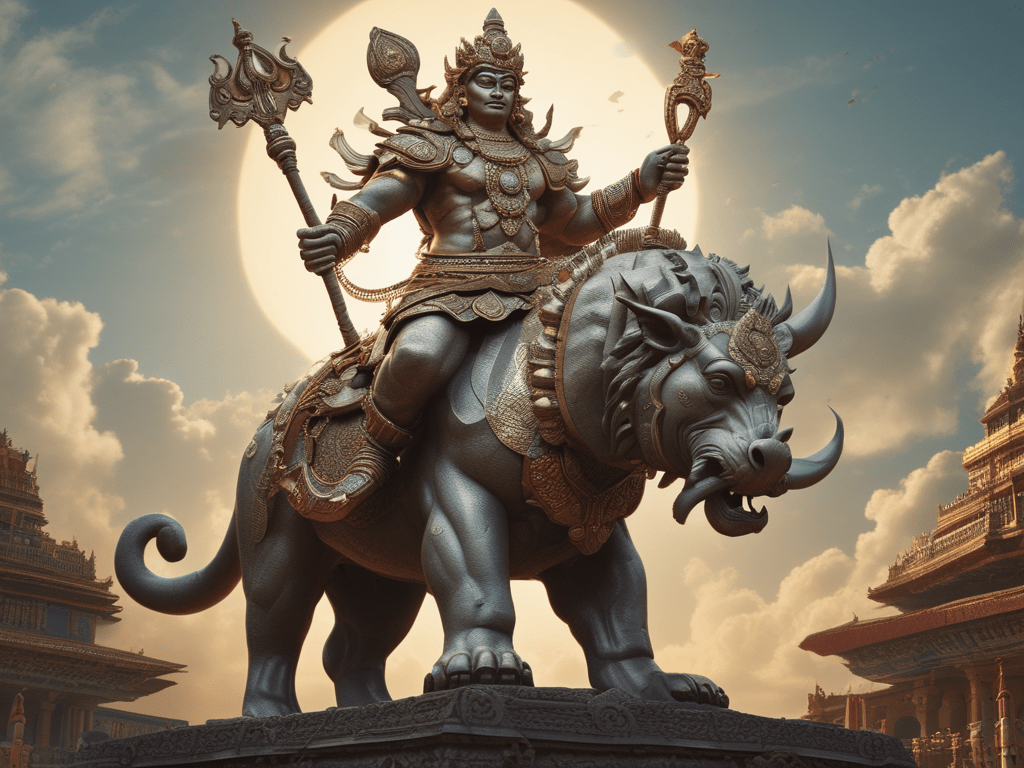
Indra is one of the most prominent deities in the Vedic and Hindu pantheon. Known as the Heavenly Warrior, he embodies spiritual strength, energy and power. Ancient texts, such as the Vedas, the epics of the Mahabharata and the Ramayana, are full of stories illustrating his glorious exploits and his numerous victories.
Origins and Iconography
Indra is often depicted as a sturdy warrior, riding a white elephant named Airavata and holding lightning (vajra) in his right hand. This iconography symbolizes his domination over the skies and his ability to control natural elements, including storms and rains. He is also sometimes shown with a bow and arrows, reinforcing his image as a warrior god.
Indra in the Vedas
The Vedas, particularly the Rig Veda, contain many hymns dedicated to Indra. He is described as the heavenly warrior, the destroyer of demons and the protector of humanity. His bravery and strength are unmatched, and he is often invoked to bring rain and fertility, vital to the cultures and survival of Vedic peoples.
Legendary Exploits and Stories
1. Victory over Vritra: One of Indra’s most famous feats is his victory over Vritra, a serpent demon who held back the waters of the world. Using his vajra, Indra killed Vritra, releasing the waters and bringing rain, which allowed the revitalization of the earth. This act is symbolic of the victory of order over chaos and life over drought.
This legend could hide a natural disaster: A super volcano off the coast of Japan 7,300 years ago.
2. The Liberation of the Heavenly Cows: Another notable story is that where Indra frees the heavenly cows held by the Panis demons. By doing this, he guarantees abundance and prosperity for gods and humans. Cows, symbols of wealth and fertility, represent Indra’s generosity towards his worshipers.
This legend tells us of a total eclipse that occurred on the banks of Indus on February 19, 3929 BCE.
3. Help for Epic Heroes: In the epics of Mahabharata and Ramayana, Indra also plays an important role. He is the father of Arjuna, one of the heroes of the Mahabharata, and offers him divine weapons and a celestial chariot to support him in the battle of Kurukshetra. In the Ramayana, he helps Rama by providing him with celestial weapons to fight the demon Ravana.
Indra and His Place in Contemporary Hinduism
Although Indra’s popularity has declined in favor of deities like Vishnu and Shiva in post-Vedic Hinduism, he remains a respected and revered figure. Festivals and rituals, such as the Indra Jatra in Nepal, still celebrate its greatness and its role as a giver of rain and prosperity.
Conclusion
Indra, as the deification of strength and energy, embodies the qualities necessary to overcome obstacles and ensure Enlightenment during sacrifice. His legendary exploits illustrate the constant struggle between good and evil, order and chaos, while emphasizing the importance of divine power in the protection and prosperity of humanity. Indra remains an iconic figure in Indian mythology, representing the divine force that governs the natural elements and protects the cosmos.
 Le Rig Veda
Laisser un commentaire