Étiquette : indus
-

The Rig Veda and the notion of cosmic cycle: birth and dissolution of the universe
The Rig Veda, humanity’s oldest sacred text, offers a fascinating vision of the cosmic cycles that govern the universe. In the tradition of the Seven Rivers civilization, the cosmos is not seen as a fixed creation, but as a perpetual process of birth, growth, decline and dissolution, before being reborn. This idea of a cosmic…
-

Vedic Hymns as Reflections of a Pre-Urban Society
The hymns of the Rig Veda, considered the oldest body of literature known to mankind, offer a unique window into a time long before the emergence of the great cities of the Seven Rivers civilization, known as the Indus-Sarasvati civilization. In particular, mandalas 2, 3, 4, 5, 6, and 7 are often considered the oldest…
-

Les influences afghanes dans l’artisanat de Ganweriwala
Ganweriwala, une des grandes villes de la civilisation des 7 rivières, est située dans l’actuel désert du Cholistan, au Pakistan. Bien que cette cité soit moins connue que Mohenjo-Daro ou Harappa, elle offre des indices fascinants sur les échanges culturels et commerciaux de cette civilisation. Parmi ces influences, les traces afghanes dans l’artisanat de Ganweriwala…
-
Afghan influences in Ganweriwala crafts
Ganweriwala, one of the great cities of the Seven Rivers Civilization, is located in what is now the Cholistan Desert in Pakistan. Although this city is less well known than Mohenjo-Daro or Harappa, it offers fascinating clues about the cultural and commercial exchanges of this civilization. Among these influences, the Afghan traces in the craftsmanship…
-

L’impact des phénomènes naturels sur la spiritualité védique
Dans la civilisation des 7 rivières, les forces naturelles jouaient un rôle central dans la spiritualité et les pratiques rituelles. Les textes védiques, en particulier le Rig Veda, révèlent une profonde connexion entre les éléments naturels et la quête spirituelle de cette civilisation. Ces forces étaient souvent perçues comme des manifestations divines, incarnant des principes…
-
The Impact of Natural Phenomena on Vedic Spirituality
In the Seven Rivers civilization, natural forces played a central role in spirituality and ritual practices. Vedic texts, particularly the Rig Veda , reveal a deep connection between natural elements and the spiritual quest of this civilization. These forces were often seen as divine manifestations, embodying both cosmic and human principles.
-

Les fouilles archéologiques à Banawali : un trésor sous terre
Banawali, une ancienne ville de la civilisation des 7 rivières, se situe aujourd’hui dans l’État de l’Haryana, en Inde. Ce site archéologique, découvert dans les années 1970, a révélé des vestiges fascinants qui nous offrent un aperçu unique de la vie quotidienne, de l’artisanat et de l’organisation sociale de cette civilisation millénaire.
-
Archaeological excavations in Banawali: an underground treasure
Banawali, an ancient city of the Seven Rivers Civilization, is located in the present-day state of Haryana, India. This archaeological site, discovered in the 1970s, has revealed fascinating remains that offer us a unique insight into the daily life, crafts and social organization of this ancient civilization.
-

The disappearance of sacred waters and the end of Soma
The Seven Rivers Civilization, which stretched along the fertile Indus and Sarasvati valleys, experienced a major upheaval around 2200 BCE. This event marked a turning point in its history, due to a prolonged drought that transformed the landscapes and spiritual practices.
-
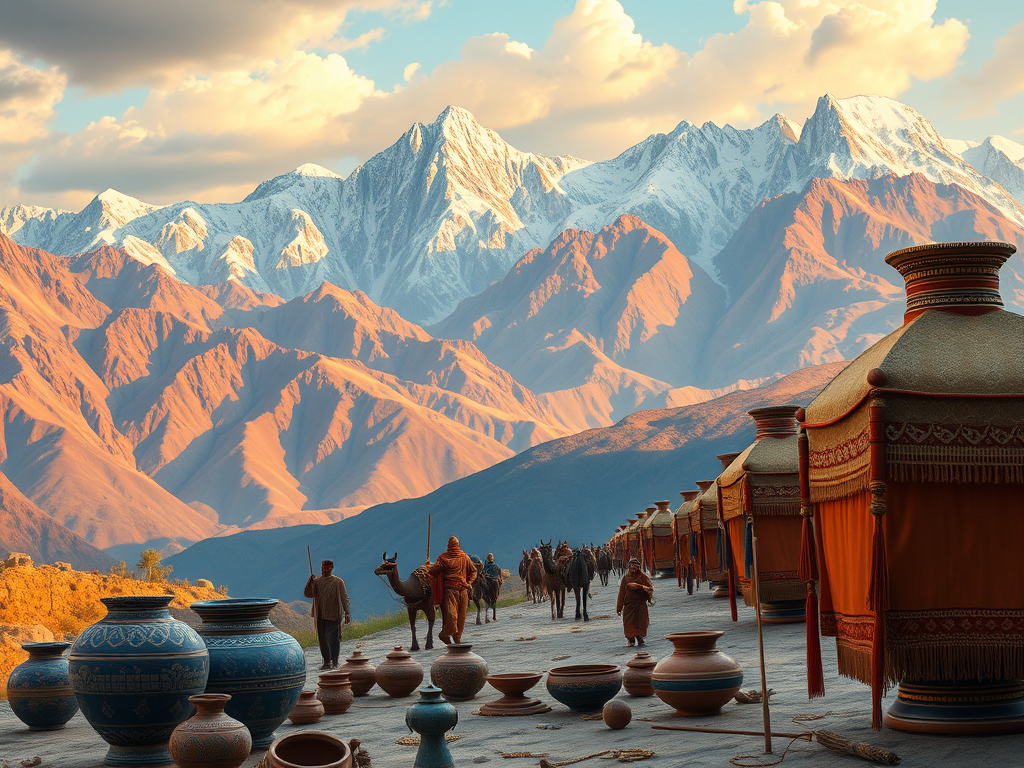
The relationship between the cities of Sarasvatî and the Afghan mountains
The Seven Rivers Civilization, known for its advanced urban planning and cultural exchange, was primarily located around the Sarasvati Valley. However, its connections extended far beyond, reaching into the mountains of Afghanistan. These connections were crucial for trade, natural resources, and cultural exchange.
 Le Rig Veda