Catégorie : Non classé
-
Mandala 7, Hymn 35
English Version Introduction This hymn belongs to the 7th mandala of the Rig Veda, which recounts the great battle of the ten kings. This war opposed a coalition of ten tribes – five Aryas (Vedic) and five non-Aryas – against King Sudāsa, ruler of the Bharatas. Sudāsa’s victory led to the unification of the Arya…
-
Mandala 7, Hymne 35
Présentation Cet hymne appartient au 7ᵉ mandala du Rig Veda, marqué par la grande guerre des dix rois. Ce conflit opposa une coalition de dix tribus – cinq aryas (védiques) et cinq non-aryas – au roi Sudâsa, chef des Bharatas. La victoire de Sudâsa permit ensuite l’unification des clans aryas en un seul peuple védique,…
-
🌍 English Version- Mandala 8, Hymn 21
Rig Veda – Mandala 8, Hymn 21 To Indra, Sarasvatī, and CitraRishi: Sobhari KāṇvaMetres: kakubuṣṇik; nicṛtpaṅkti; virāḍuṣnik; pādanicṛtpaṅkti; nicṛduṣṇik; bhurikpaṅkti; virāṭpaṅkti Summary This hymn addresses Indra, the god of strength and thunder, while invoking Sarasvatī, the sacred river and source of inspiration, as well as Citra, a radiant deity. The faithful ask for protection, abundance,…
-
Rig Veda – Mandala 8, Hymne 21
Rig Veda – Mandala 8, Hymne 21 À Indra, Sarasvatī et CitraRishi : Sobhari KāṇvaMètres : kakubuṣṇik ; nicṛtpaṅkti ; virāḍuṣnik ; pādanicṛtpaṅkti ; nicṛduṣṇik ; bhurikpaṅkti ; virāṭpaṅkti Résumé Cet hymne s’adresse à Indra, le dieu de la force et du tonnerre, tout en invoquant Sarasvatī, la rivière sacrée et source d’inspiration, ainsi que…
-
Let’s decipher the metaphors.
Hymn to Agni: Understanding the Sacred FireRig Veda – Hymn to Agni (Shlokas 1, 2, 3, 5, 9) Agni is portrayed in the Rig Veda as the god of fire and the priest of sacrifice. He is both a spiritual guide and a bestower of wealth. The hymn begins: 1 – I sing of Agni,…
-
Décryptons les métaphores.
Hymne à Agni : Comprendre le Feu Sacré Rig Veda – Hymne à Agni (Shlokas 1, 2, 3, 5, 9) Agni est présenté dans le Rig Veda comme le dieu du feu et le prêtre du sacrifice. Il est à la fois le guide spirituel et le dispensateur de richesses. L’hymne commence ainsi : 1…
-

L’importance des mantras dans la tradition du Rig Veda
Le Rig Veda est un chant. Pas un livre à lire assis dans un fauteuil, mais un ensemble de mantras récités à voix haute, lors des sacrifices. Chaque vers est une vibration. Chaque mantra est un appel, une louange, une ouverture de l’esprit à la Lumière intérieure.
-
The importance of mantras in the Rig Veda tradition
The Rig Veda is a chant. Not a book to be read while sitting in an armchair, but a set of mantras recited aloud during sacrifices. Each verse is a vibration. Each mantra is a call, a praise, an opening of the mind to the inner Light .
-
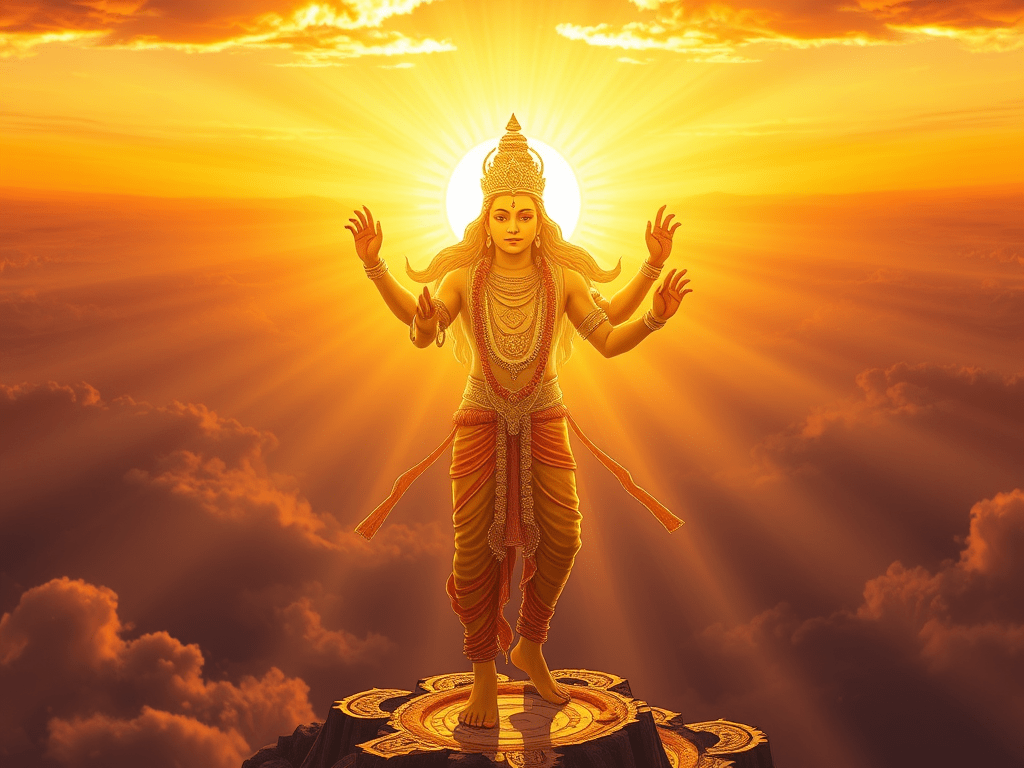
Vivasvān : représentation éclatante du soleil, un des Adityas
Vivasvān est une figure importante dans les textes védiques. Il représente le soleil, non pas seulement comme un astre, mais comme une présence lumineuse, vivante, éclatante. Son nom vient de la racine sanskrite vi-vas, qui veut dire “briller”, “diffuser la lumière”.
-
Vivasvān: a brilliant representation of the sun, one of the Adityas
Vivasvān is an important figure in Vedic texts. He represents the sun, not just as a star, but as a luminous, living, and radiant presence. His name comes from the Sanskrit root vi-vas , which means “to shine,” “to diffuse light.”
 Le Rig Veda