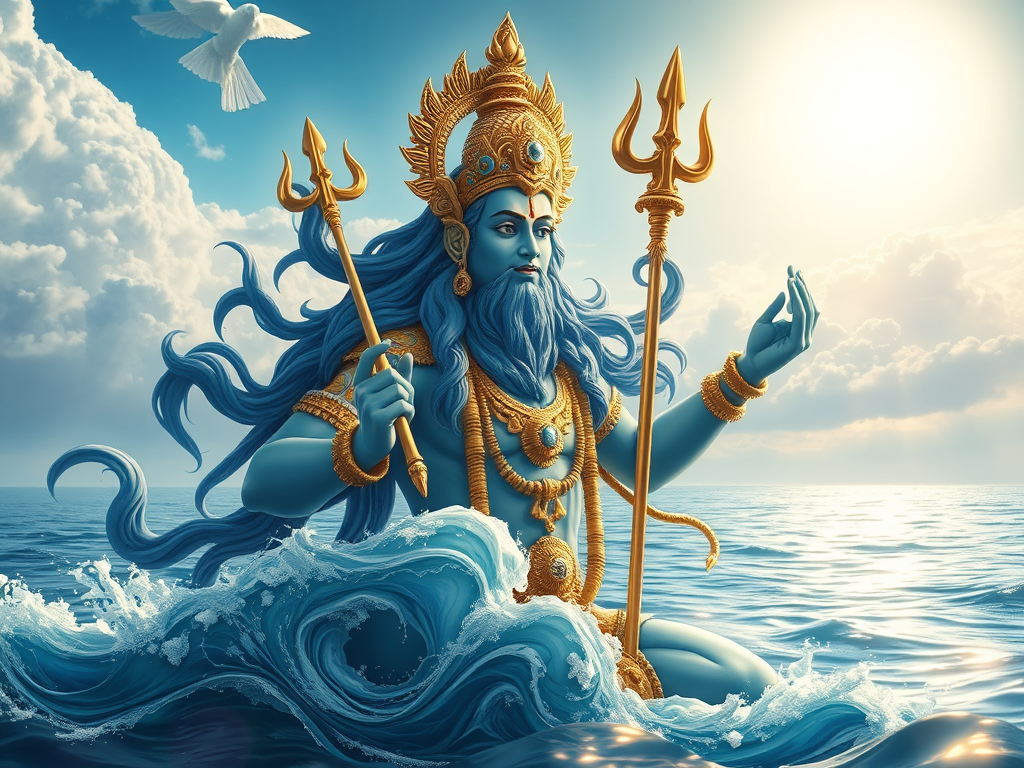
In the Vedic hymns, Varuna is not a spectacular deity.
He does not strike, does not fight, does not thunder.
He surrounds .
Varuna is the force that keeps the world in order,
the one that links heaven, earth, waters and living beings
in an invisible but implacable coherence.
1. Varuna: « that which surrounds »
The name Varuna refers to the idea of wrapping , binding , that which contains .
In the Rig Veda, Varuna is not localized:
he is everywhere order exists.
He is associated with:
- to the night sky,
- to deep waters,
- to the invisible laws that govern the world.
Varuna is not a personal god.
He is a cosmic principle .
2. Cosmic order before morality
The hymns often speak of Varuna as the guardian of the ṛta .
The ṛta is not morality in the modern sense.
It is the natural order of things :
- the cycle of days and nights,
- the movement of the stars,
- the consistency between actions and their consequences.
Varuna does not punish out of anger.
He restores order when it is broken.
3. Varuna and the truth
Varuna is closely linked to the truth .
But again, this is not about intellectual or ideological truth.
It is about inner truth .
In the anthems:
- Varuna sees everything.
- Nothing can be hidden from him.
- neither actions nor thoughts.
This gaze is not oppressive.
It is clarifying .
To lie is to be out of sync with the cosmic order.
To tell the truth is to realign oneself.
4. An inner relationship, not a cult of fear
Some have tried to portray Varuna as a stern god.
The hymns tell a different story.
They are talking about:
- trust,
- an appeal for understanding,
- desire to remain in harmony with the world.
The rishis do not fear Varuna.
They seek to live justly , in the cosmic sense of the term.
5. Varuna, an all-encompassing consciousness
Varuna represents a broad, silent, stable consciousness.
A consciousness that:
- encompass without judgment
- maintains without constraint,
- commands without dominating.
In a civilization where the ego was not central,
Varuna reminded us that humans are part of a larger whole.
Conclusion
Varuna is not a moral judge.
He is the very order of the world ,
the truth that connects beings to that which transcends them.
His hymns do not speak of submission,
but of agreement .
When a human acts justly,
they are at peace with Varuna,
because they are at peace with reality.
 Le Rig Veda
Laisser un commentaire