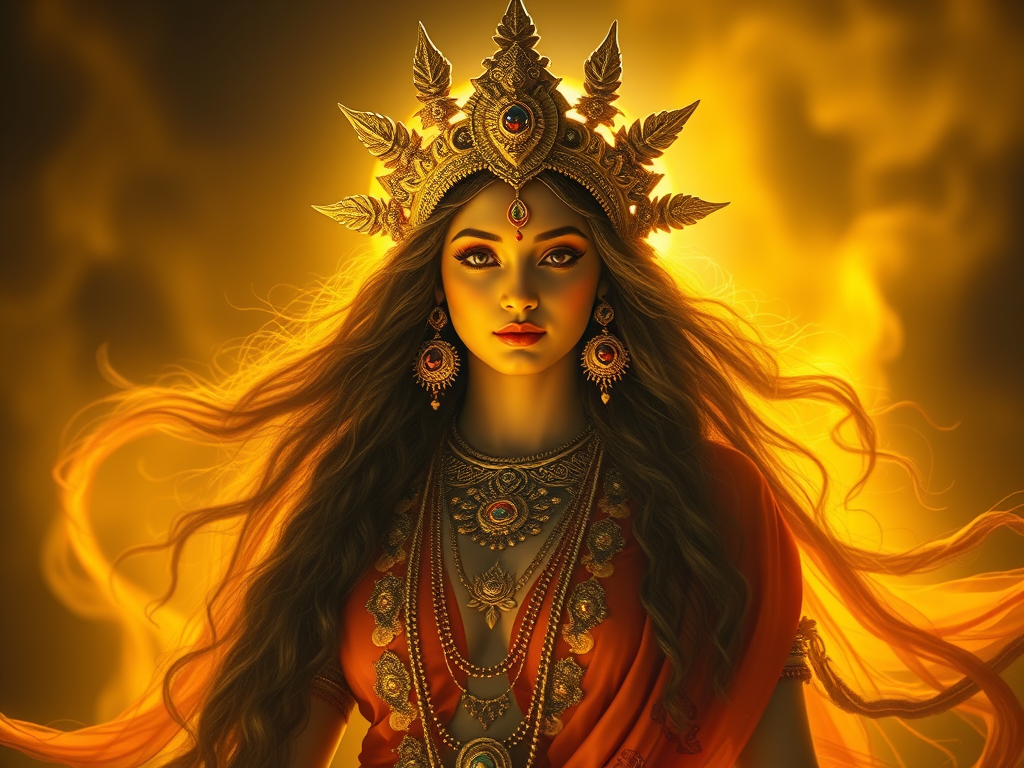
In the Vedic hymns, Ushas holds a unique place.
She is neither fierce nor distant.
She arrives quietly, every morning.
Ushas is the Dawn.
But above all, she represents the awakening of consciousness.
1. Ushas is more than a morning goddess
In the Rig Veda, Ushas is invoked repeatedly as a lived reality.
When Ushas appears:
- darkness withdraws,
- fear fades,
- clarity arises.
This is not only about sunrise.
It is about inner awakening.
2. Dawn as a metaphor for illumination
The rishis describe illumination not as a sudden shock,
but as a gentle arrival of light.
Before Ushas: confusion, inertia, inner night.
With Ushas: clarity, movement, understanding.
Ushas does not blind.
She reveals.
3. Ushas and awakened consciousness
The hymns say that Ushas:
- awakens beings,
- restores movement to the world,
- brings life back to what was dormant.
This mirrors the awakened state of consciousness:
the world is unchanged, yet fully perceived.
4. An illumination open to everyone
Ushas rises for all beings.
She does not discriminate.
Illumination, in early Vedic thought, is not reserved for a few.
It is part of life itself.
Each dawn is an opportunity for inner awakening.
Conclusion
Ushas is not a distant deity.
She is the moment when consciousness opens.
The hymns do not describe belief,
but direct experience.
Ushas is the dawn of the day —
and the dawn of human illumination.
 Le Rig Veda
Laisser un commentaire