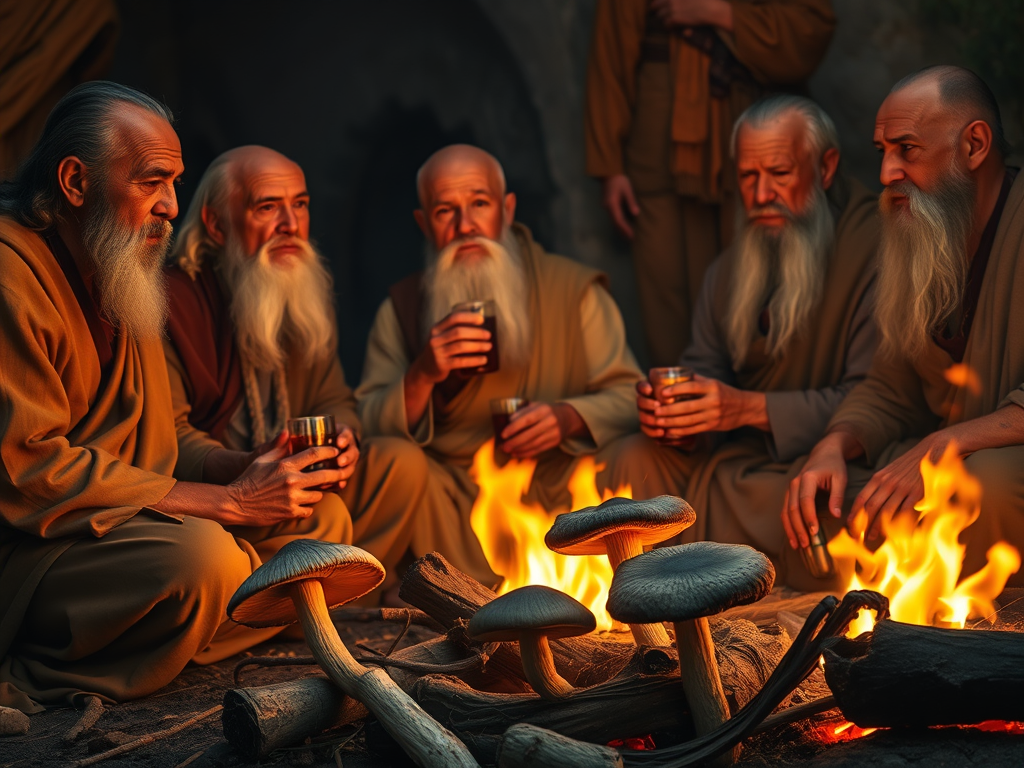
In Vedic hymns, Soma occupies a central place.
It is drunk, sung, pressed, and filtered.
It illuminates the mind and dissolves fears.
But one question remains, still avoided by many:
who was Soma really?
Hymns provide more clues than one might think.
1. Soma was not an ordinary drink
In the Rig Veda, Soma is never described as a classic plant.
It is said:
- without leaves ,
- without flowers ,
- seedless ,
- without visible roots .
It does not grow like a shrub.
It is not cultivated like a field of grain.
One term often comes up to refer to it: amśu .
Amśu means fiber , filament , thin stem .
This word perfectly describes a fungus , not a plant.
2. Soma and psilocybe
The Vedic descriptions agree with an entheogenic mushroom , most likely a psilocybe .
For what ?
- rapid growth after rain,
- absence of leaves and seeds,
- fibrous structure (amśu),
- direct effects on consciousness.
The hymns describe typical effects:
- dissolution of the ego,
- luminous visions,
- feeling of unity,
- disappearance of the fear of death.
This is not about alcoholic intoxication.
It is about an expansion of consciousness , clear and lucid.
3. A sacred intoxication, not a stupefaction
Yes, the hymns speak of intoxication.
But this intoxication is sacred .
It doesn’t confuse the mind.
It makes it clear.
Under Soma:
- The speech becomes inspired.
- Thought becomes simpler.
- The understanding is immediate.
The rishis do not « compose » the hymns:
they receive them in this state of open consciousness.
4. Soma for all, not for an elite
Contrary to what has long been claimed, Soma was not reserved for a caste.
The wealthy and the priests had public rituals.
But ordinary people could consume Soma at home , with or without a priest.
Enlightenment was not a privilege.
It was part of normal life in the Seven Rivers civilization.
5. The disappearance of Soma: around 2200 BCE
Soma doesn’t disappear by chance.
Around 2200 BC , a major intertropical drought struck all of Asia, the Middle East, and North Africa.
This climate crisis is causing:
- the drying up of numerous rivers,
- the collapse of entire cultures,
- the gradual disappearance of Soma in its natural state.
Without Soma:
- the direct experience of enlightenment recedes,
- The rituals become mechanical.
- Spirituality is becoming rigid.
This is a major turning point.
Conclusion
So, was Soma a form of intoxication?
Yes.
But a sacred intoxication ,
linked to an entheogenic mushroom ,
integrated into a civilization where consciousness mattered more than power.
His disappearance, around 2200 BCE , marks the end of a world:
one where enlightenment was experienced, not theorized.
The Rig Veda is not a myth.
It is the memory of a real human experience —
now largely forgotten.
 Le Rig Veda
Laisser un commentaire