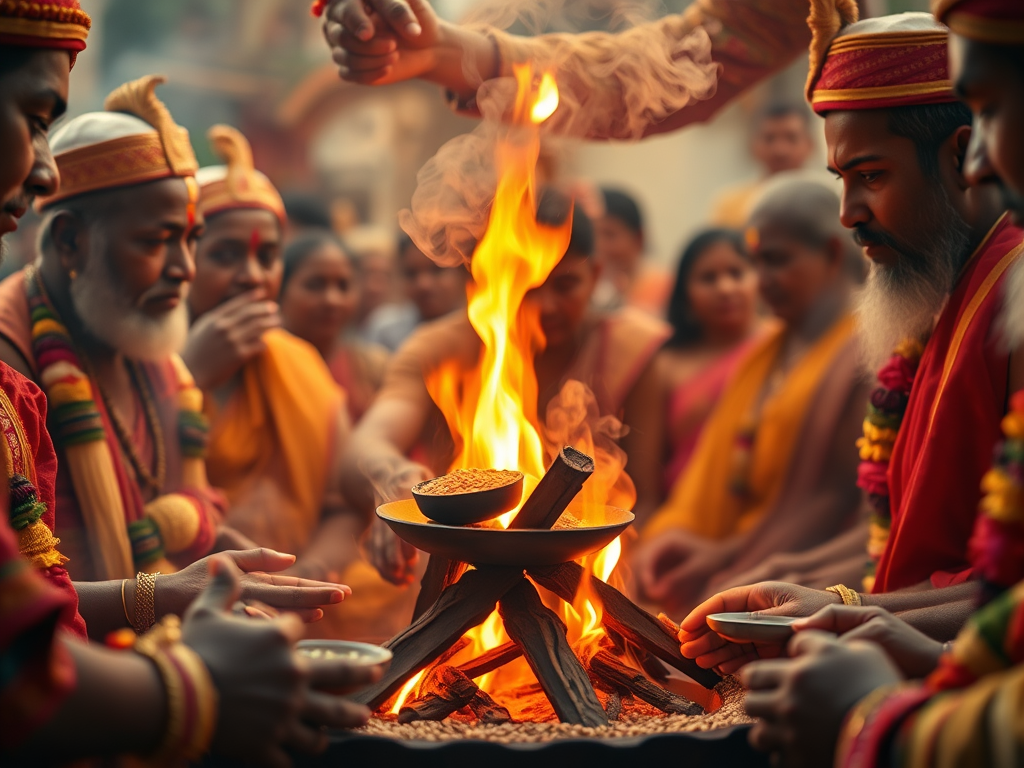
Agni is one of the most important figures in the Rig Veda.
He appears in the very first hymn of the book, as if to remind us that everything begins with fire: the fire of the home, the fire of the ritual, and above all the inner fire, the one that illuminates, purifies, and awakens consciousness.
The hymns dedicated to Agni do not speak only of visible flames.
They describe a living energy, present in every human being, a force that opens the path toward clarity and illumination.
1. Agni: light, warmth, and life
In the Rig Veda, Agni is not just physical fire.
He represents:
- inner light,
- warmth of the heart,
- vital strength,
- the awakening of consciousness,
- knowledge that dissolves darkness.
Agni is what allows us to see, to understand, to discern.
Without him, everything remains confused.
With him, everything becomes possible.
This is why the rishis lit him every morning — not only in their homes, but within themselves.
2. Agni as the messenger between the human and the divine
Many hymns call Agni the messenger.
He carries the offerings “to the gods”, but this image describes an inner reality:
Agni is the bridge between:
- what we feel,
- what we aspire to,
- and the expanded state of consciousness.
In simple terms:
Agni transforms what we give him (our thoughts, intentions, and blockages) into clarity and renewed energy.
He is the mediator between the inner world and the spiritual world.
3. The fire that purifies and transforms
Fire transforms whatever it touches:
it consumes, illuminates, warms, and changes things from one state to another.
In the hymns, Agni does exactly this:
- he burns fears,
- he reduces illusions to ashes,
- he purifies thought,
- he cleans the mind of impurities,
- he transforms raw energy into conscious light.
The Rig Veda shows that illumination is not a gift, but an inner process:
we nourish Agni, and Agni transforms us in return.
4. Agni: the inner guide
Some hymns describe Agni as a guide.
He walks ahead, lights the path, and protects those who seek truth.
In inner life, this means:
- choosing clarity over confusion,
- listening to the small inner flame that knows,
- acting with lucidity rather than impulse,
- continuing to walk even in darkness, guided by a quiet inner fire.
Agni is this calm and luminous presence that shows the direction when all feels uncertain.
5. The fire we must nourish every day
In the Civilization of the Seven Rivers, the household fire was lit each morning.
This simple gesture symbolized a deep truth:
the inner fire too must be nurtured every day.
The hymns say it clearly:
- Agni grows when he is called,
- he fades when he is forgotten,
- his brightness depends on our attention.
To nourish Agni means practicing:
- clarity,
- sincerity,
- inner truth,
- vigilance,
- simplicity.
The stronger Agni becomes, the more luminous consciousness becomes.
6. The inner Agni as the first step toward illumination
Agni is not the end of the path.
He is the beginning, the key, the first spark.
He opens the way for:
- Indra (strength),
- Soma (expanded awareness),
- Sarasvatī (inspiration),
- Varuna (inner order and truth).
Without Agni, nothing starts.
With Agni, everything can awaken.
The Rig Veda shows that illumination is not a sudden revelation, but a gradual rising of light, made possible by a strong and clear inner fire.
Conclusion
The hymns to Agni do not speak only of fire.
They speak about us —
the fire we carry within,
the light we can nurture,
and the path that this light opens in consciousness.
Agni is:
- the first step,
- the first spark,
- the first breath of light.
He guides us toward a deeper vision, toward inner transformation, and toward illumination.
 Le Rig Veda
Laisser un commentaire