Luminous Forces of the Civilization of the Seven Rivers
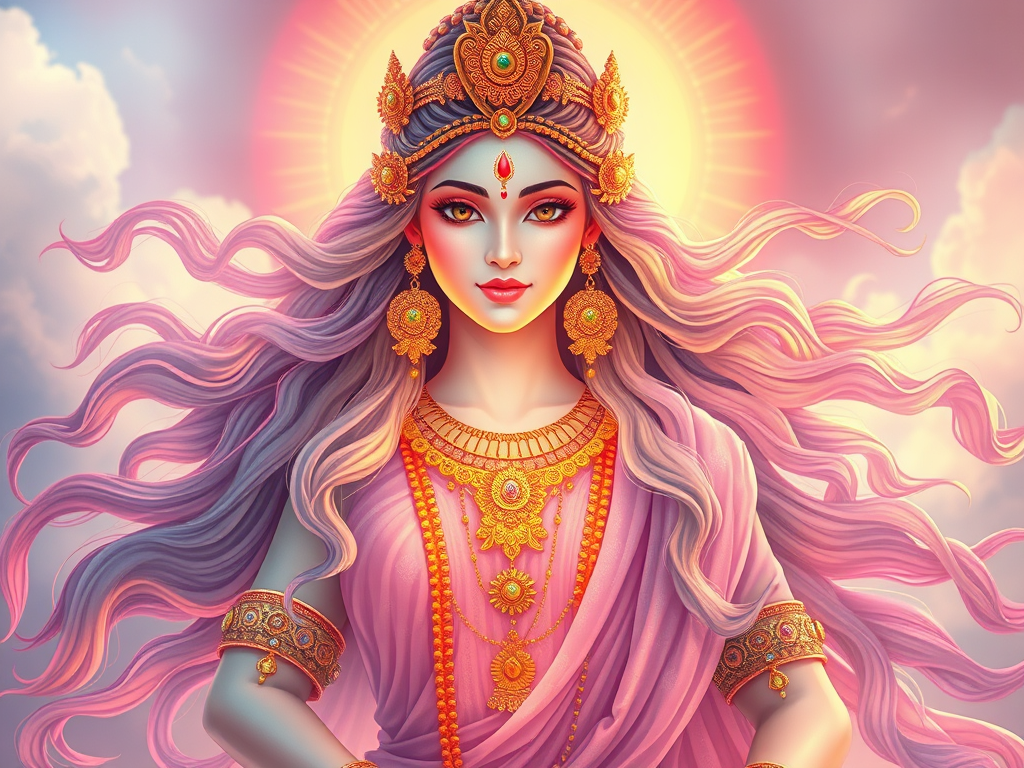
The Vedic texts, especially the Rig Veda, often describe natural forces as goddesses. They are not human beings turned into deities but cosmic principles, living energies, guiding human beings toward inner clarity. They represent light, knowledge, harmony, and the right movement of life.
Here are the main Vedic goddesses, presented simply.
Aditi: the Infinite, the Cosmic Mother
Aditi is one of the most important figures in the Rig Veda.
Her name means “unbound, limitless.” She represents:
- infinity,
- freedom,
- boundless space,
- the source of all life.
She is the mother of the Adityas, the luminous forces that uphold ṛta, the order of the world.
Aditi is not a “mother” in the human sense. She is vastness itself, the open, limitless presence in which consciousness expands.
Ushas: the Dawn, the Birth of Light
Ushas is the goddess of the Dawn, one of the most beautiful figures of the Rig Veda.
She appears each morning, bringing:
- light,
- renewal,
- hope,
- the awakening of awareness.
In the hymns, she dispels darkness and opens the path forward.
She is not only the outer sunrise: she is the inner dawn, the moment consciousness emerges from confusion.
Sarasvatī: inspiration, pure speech, sacred river
Before becoming the goddess of arts, Sarasvatī is, in the Rig Veda:
- a river,
- a source of inspiration,
- the movement of pure speech.
Her name means “she who flows.” She is the sacred river of the Civilization of the Seven Rivers, the very heart of their land.
She brings clarity, lucidity, and inspiration. She helps truthful speech, understanding, and learning.
Sarasvatī is the fluid movement of knowledge.
Ilā: the nourishing Word
Ilā is a more discreet but essential figure.
She embodies:
- inner inspiration,
- the revealing word,
- intuitive understanding.
In the Vedic tradition, Ilā guides the rishis in their chants, giving precision and truthfulness.
She is the inner path leading toward truth.
Other important feminine figures
Prithivī
The living Earth: stable, nourishing, supportive. She is the foundation that makes life and spiritual practice possible.
Rātrī
The Night. Not negative darkness, but the quiet that allows rest, silence, and incubation.
Sinivālī & Kuhū
Lunar forces linked to cycles, beginnings, fertility, and the movement of time.
Conclusion
Vedic goddesses are not “gods” in the modern sense.
They represent states of consciousness, forces of nature, and inner movements.
They accompany the human being on the path to clarity, harmony, and openness.
For the Civilization of the Seven Rivers, these forces were not outside human beings: they lived within, vibrant and accessible.
 Le Rig Veda
Laisser un commentaire