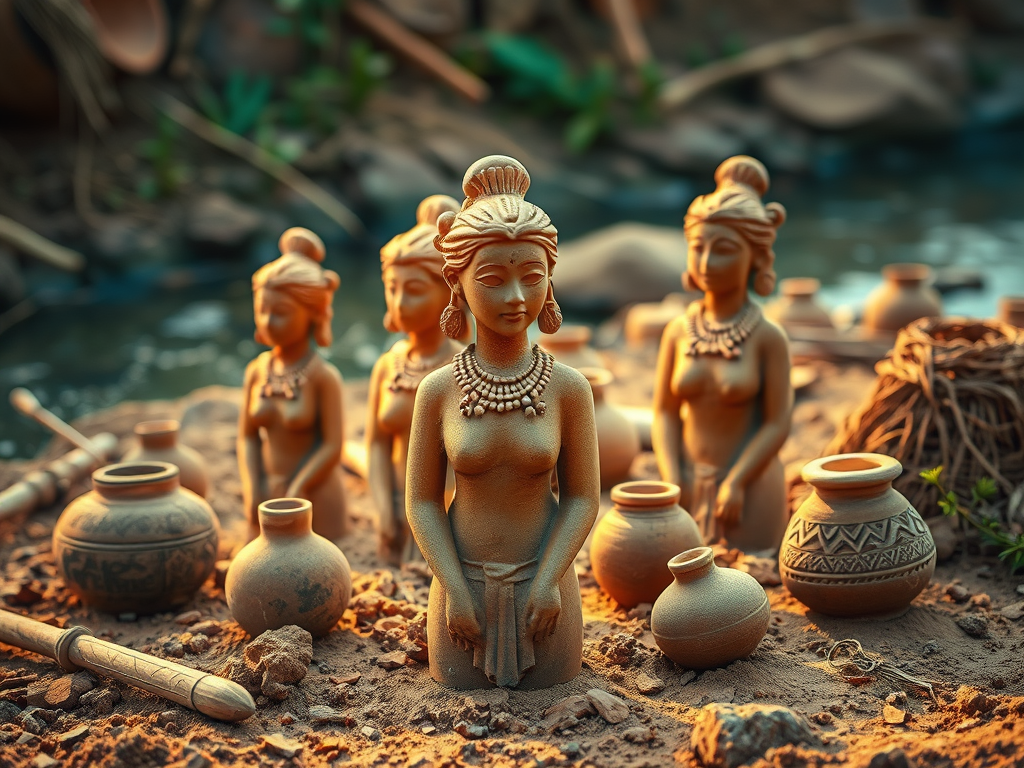
The Seven Rivers Civilization, also known as the Sapta Sindhu , developed between the Indus and Sarasvati rivers over 4,000 years ago. This ancient civilization, often associated with cities such as Rakhigarhi, Bhirrana, and Kalibangan, continues to amaze researchers. Among the topics that remain little known, the role of women in these societies is beginning to emerge thanks to archaeological discoveries.
Objects that speak to women’s daily lives
Excavations at several Sarasvati sites have unearthed numerous objects related to domestic life, as well as crafts, religion, and leisure. Terracotta female figurines have been found, often highly detailed, sometimes with jewelry, hairstyles, or decorated clothing. These objects demonstrate that women occupied an important place in the culture of this civilization.
Some of these figurines may represent mothers, dancers, or figures associated with fertility. They suggest that women played a role in local rituals or beliefs.
A society where women participated in the economy
Several bead, ceramic, and textile workshops were discovered in the houses. It is possible that women were actively involved in these. The tools found—such as spindles or weaving tools—were sometimes associated with domestic spaces, suggesting that they produced useful objects for the family, but perhaps also for exchange with other villages.
Women were therefore able to play a role in crafts, and therefore in the local economy. This demonstrates a form of autonomy and participation in community life.
Visible equality in burials?
Some graves found at sites like Rakhigarhi show little difference between male and female burials. Women were buried with pottery, ornaments, and sometimes even valuables. This suggests that they were respected in society and could hold a position comparable to that of men in certain areas.
A society without war, where the feminine had its place
The Seven Rivers civilization shows no evidence of armies, fortresses, or organized violence. This absence suggests a society focused on peace, local organization, and cooperation. In such a context, women may have played a central role in the family, in trade, and in the transmission of knowledge.
Conclusion
Thanks to archaeological excavations in the Sarasvati region, we are gradually discovering the role of women in the Seven Rivers civilization. Present in daily life, active in crafts, respected in death, they seem to have occupied an important place in this ancient society. Far from clichés, this civilization offers us the image of a world where women were visible, active, and recognized.
 Le Rig Veda
Laisser un commentaire