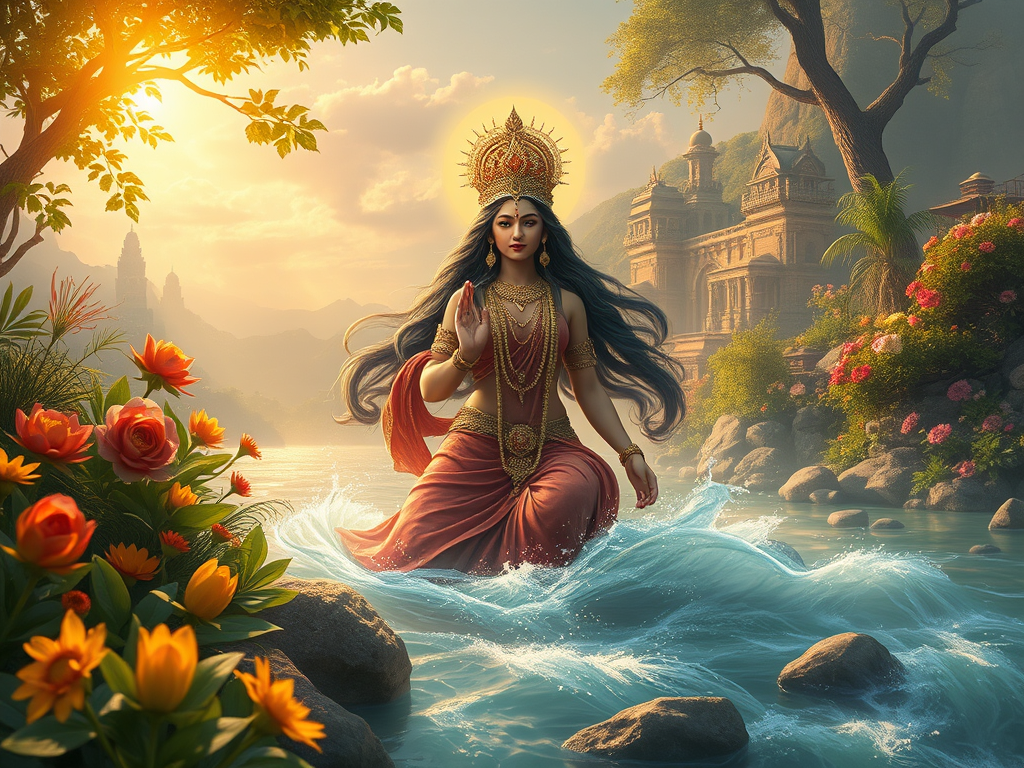
The goddess Sarasvati occupies a central place in the ancient hymns of the Rig Veda. She is not only a deity of knowledge, speech, and wisdom: she is also an actual river, very present in the lives of the people of the Seven Rivers Civilization . She is the only river to be also a goddess. She directly connects the natural world to the spiritual universe.
Sarasvati, goddess and river at the same time
Of all the rivers mentioned in the Rig Veda, Sarasvati is the only one honored as a goddess in her own right. She is described as powerful, swift, and nurturing, but also inspiring, far-sighted, and the protector of sacred chants. Hymns are addressed to her to request inspiration, clarity of mind, and strength of speech.
In the Rig Veda 6.61 , she is called » the great among the great , » and in the famous hymn 2.41.16 , she is called » Best of mothers, best of rivers, best of goddesses . » She is praised for her purity, for her spiritual power, but also for her physical presence, which is indispensable to the lives of the inhabitants.
The Purus and the Bharatas on its two banks
The Rig Veda mentions in hymn 7.96.2 that the Purus , from whom the Bharatas descended , lived on both banks of the Sarasvati. These people formed the heart of the Seven Rivers Civilization , an ancient, peaceful culture, advanced in terms of urban planning and social organization.
The fact that Sarasvati was both a physical river and a deity shows how central she was to their lives, both material and spiritual. She represented fertility, wisdom, and right speech.
The most important river of the 7 Rivers civilization
For centuries, the Sarasvati was the main river of this entire civilization. It crossed a vast region that included hundreds of villages and very well-organized towns, such as Rakhigarhi , Kalibangan or Bhirrana . It allowed agriculture, trade, but also Vedic rituals.
This importance was gradually forgotten in the following centuries, as the Sarasvati dried up around 1900 BCE . Two earthquakes changed the course of its main tributaries: the Yamuna, which flowed into the Drishadvati, and the Sutlej . The latter flowed into the Indus and the Drishadvati dried up. Gradually, the river disappeared into the desert. This led to the migration of people westward to the Indus basin, which became the main river at that time. This is mentioned in hymn 10.75 .
Sarasvati and knowledge
In the hymns, Sarasvati is also the one who « shines in the mind, » who « gives the light of thought. » She is prayed to to free speech, inspire poets and sages, and purify the mind. She is invoked before reciting sacred texts, as she represents truth and clarity.
It is directly linked to discernment , right speech and knowledge that elevates the spirit . It guides those who seek to understand the world beyond appearances.
Conclusion
Vedic hymns show how central Sarasvati was to the lives of the people of the Seven Rivers civilization . Both a real river and a goddess of knowledge, she nourished bodies and minds. She symbolizes a time when nature, speech, and spirituality formed a whole.
Although the river has physically disappeared, its spirit remains alive in texts, in memory and in traditions that continue to honor it today as the source of wisdom.
 Le Rig Veda
Laisser un commentaire