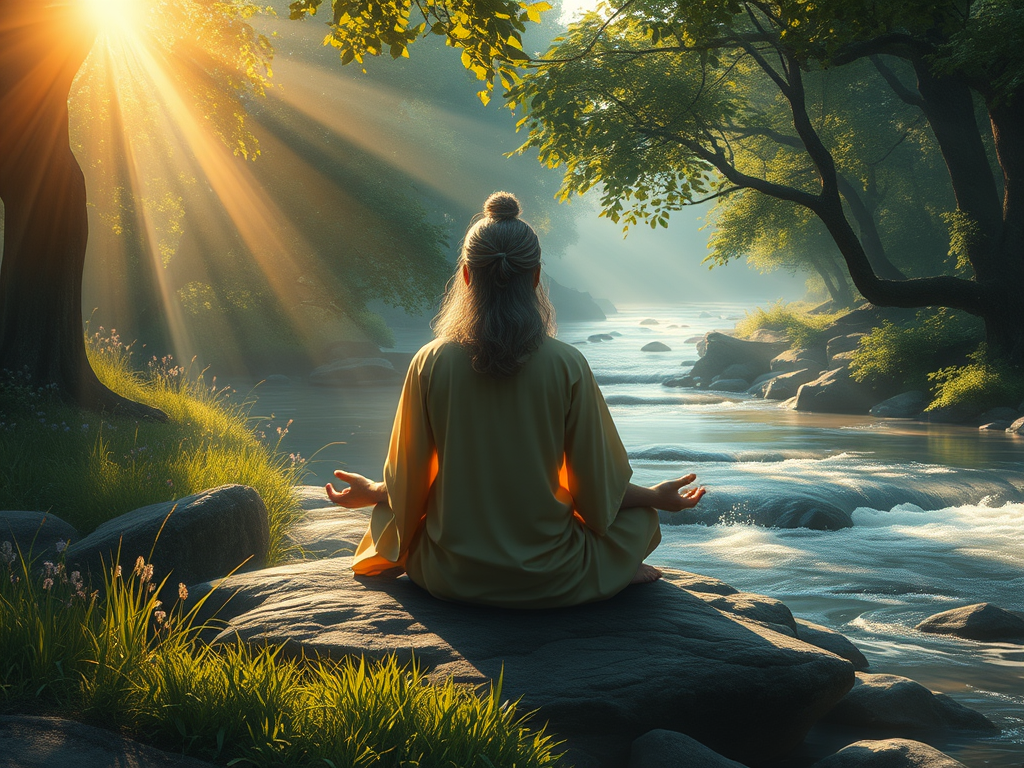
Meditation played a central role in the Seven Rivers Civilization, which flourished over 4,000 years ago in the Indus and Sarasvati Valleys. This ancient, gentle, and nonviolent civilization left behind sacred texts called the Vedas. Through these texts, we discover precise methods for calming the mind, elevating consciousness, and achieving a state of oneness with the universe. Here’s a simple, clear overview of the Vedic meditation practices used during this era to advance toward enlightenment.
1. Inner Silence Through Sound: Mantra
The Sanskrit word mantra means “instrument of thought.” It is a formula repeated mentally or in a low voice. The oldest Vedic mantra is the famous Om , considered the sound of the universe. By repeating a mantra, the mind becomes calm, thoughts slow down, and a deep peace can settle. It was a central method in the spiritual practices of the Seven Rivers Civilization.
2. Concentration on the breath: conscious breathing
In the Vedas, breath is called prāṇa . It is seen as the life force. The sages of the time learned to observe the breath, without controlling it. Just by remaining attentive to the inhalation and exhalation, the mind becomes stable. This simple practice allows one to remain present, here and now. It prepares the mind to enter into deep meditation.
3. Visualizing Inner Light
Some Vedic hymns speak of a light shining within oneself, beyond thoughts and sensations. Meditators would sit in silence and visualize this light in their heart or between their eyebrows. This light was seen as a divine presence, gentle and luminous, guiding one to inner peace and clarity.
4. Union with Nature
The ancient Rishis (sages) lived in connection with nature. They meditated near rivers, under trees, or in caves. Wind, fire, water, the sun—everything was seen as a living force. Meditating in nature was a way to feel connected to all that exists. This deep connection helped one step out of the mind, unite with the world, and elevate one’s consciousness.
5. Letting Go of the Self
In the Vedas, there is often talk of letting go of the ego, this “I” that clings to everything. In meditation, the sages sought to go beyond thoughts, emotions, and even personal identity. The goal was to rediscover the pure being, without name or form. This state of pure consciousness is sometimes called turiya , the fourth state, beyond sleep, dream, and waking.
Conclusion: A Path to Inner Peace
Vedic meditation was not a complicated technique, but a simple and straightforward path to reconnecting with oneself. In the Seven Rivers civilization, it was part of daily life. These ancient practices are still valid today. They remind us that calm, presence, and light are already within us, accessible at any time.
 Le Rig Veda
Laisser un commentaire