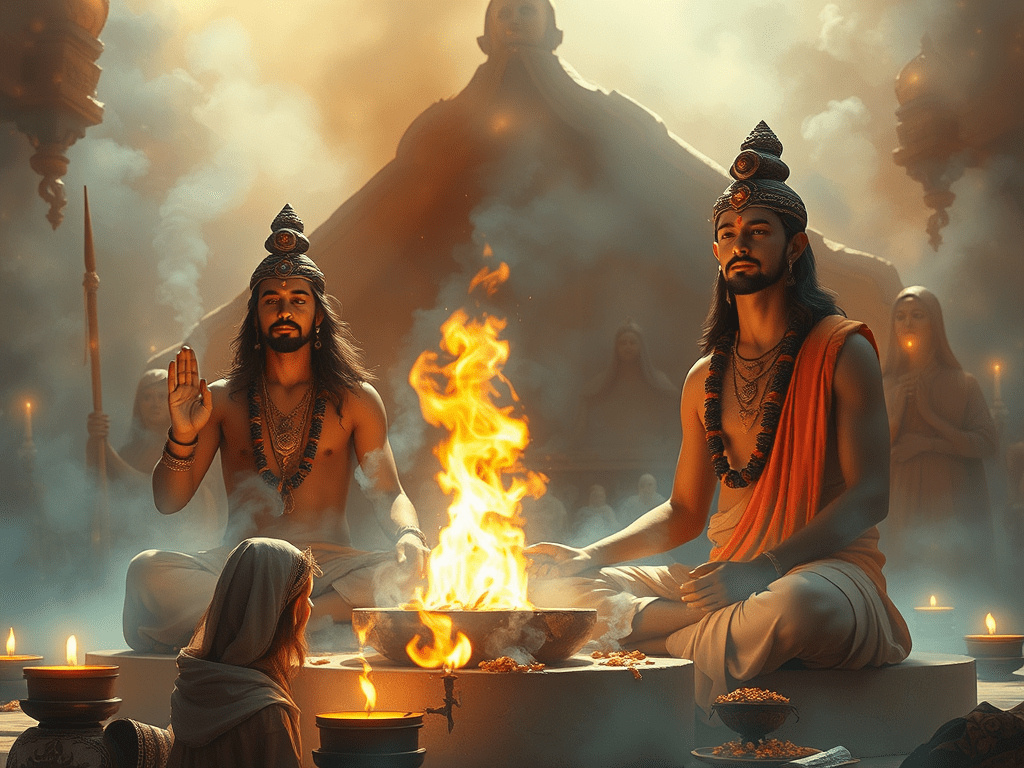
In the Seven Rivers civilization, union with the divine was at the heart of spiritual life. This union was achieved not only through rituals or prayers, but also through direct, lived, inner experience. Soma played a central role in this quest.
The ninth mandala of the Rig Veda is entirely devoted to Soma. It was so important that an entire mandala was dedicated to it in the compilation of Vedic hymns. This mandala precedes the tenth, added later. Soma is sung there as a living force, a light, a link between humans and the gods.
But what was Soma really?
It was pressed, filtered, and drunk. It is said to have no leaves, flowers, fruit, or seeds. The Sanskrit word amshu used to describe it means « filament, » « fiber. » Soma was therefore a very special plant. It did not grow like any other plant. It affected consciousness.
The third verse of Hymn 8.48 provides a valuable clue:
« We have drunk the Soma, we have become immortal;
we have attained the light,
we have found the gods.
What is hostility now for us?
And what is the deceit of a mortal? »
These lines say it all. Soma opened up another world. It broke down the barriers of the ego, of the ordinary mind. It opened the way to an inner light, to the immortality of the spirit, to total peace.
It wasn’t just an offering or a ritual drink. It was a passage. A door to the divine.
Even today, some scholars believe that Soma was an entheogenic plant, meaning a plant that opens one to the experience of the sacred. Psilocybin, a mushroom containing psilocybin, fits well with Vedic descriptions. It has no leaves, flowers, or seeds. It grows on the ground, often in humid places, associated with rain, like Soma.
Psilocybin acts on the deepest consciousness. It can induce visions, experiences of ego dissolution, sensations of light, and oneness with everything. Exactly what the Rishis seek in their hymns.
In the Rig Veda, Soma is alive. He is a god, a light, a force that rises towards the sky, like a river of fire. He flows, he illuminates, he awakens.
In the ninth mandala, we read:
« O Soma, you who blaze,
you rise within us, awakening the spirits.
You open the paths of heaven. »
What the sages of the Seven Rivers civilization seemed to seek was not merely belief or obedience to rules. It was a living union with the divine. And this union required a transformation from within.
Soma was one of the sacred tools for this transformation.
It wasn’t about fleeing the world, but about seeing it differently. It was about opening the inner eye. It was about entering into clarity. It was about reaching a state of peace, lucidity, and unity.
Soma wasn’t a drug for forgetting. It was a sacred plant for remembering. For remembering who you really are.
The Seven Rivers civilization understood this. It made Soma a central focus of its spiritual life. And today, rediscovering what these ancient texts tell us may be a way to rediscover a simple, direct path to the divine.
 Le Rig Veda
Laisser un commentaire