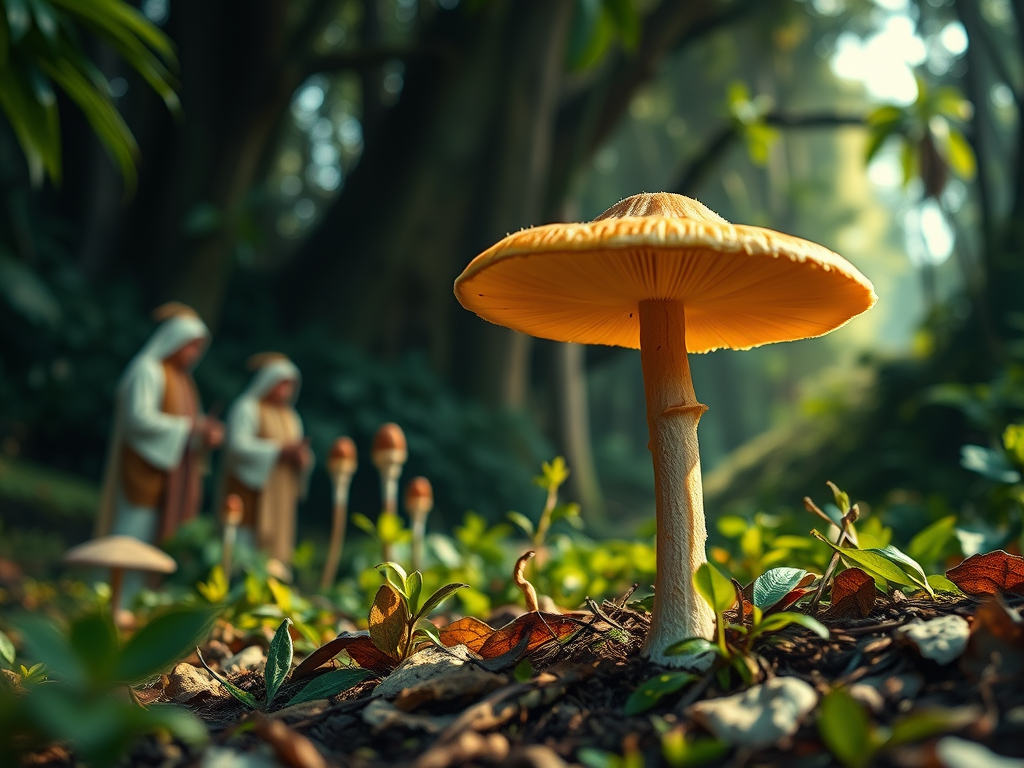
The Rig Veda, a sacred text of the civilization of the 7 rivers, mentions a mysterious drink called Soma. This divine nectar was used during rituals to enter into communion with the gods and reach altered states of consciousness.
Soma: an entheogenic plant
Soma was an entheogenic plant, that is, a plant capable of inducing mystical and spiritual experiences. Russian archaeologist Viktor Saraiadini identified a mushroom, Psilocybe cubensis , as the original Soma. He discovered a Mongolian tapestry dating from the beginning of our era depicting Avesta priests worshiping a mushroom, which supports this hypothesis.
In the Rig Veda, Soma is described as a plant without leaves, seeds, flowers or fruits, which corresponds to the mushroom Psilocybe cubensis. Additionally, the Sanskrit word amshu , meaning fiber or filament, seems to refer to the filaments of the mycelium of mushrooms.
The disappearance of Soma and the evolution of spiritual practices
Around 2200 BCE, a great drought affected the entire earth, in the intertropical region. This climate change led to the disappearance of the conditions necessary for the growth of Psilocybe cubensis. Faced with this, the priests tried to recreate the effects of Soma using other plants such as ephedra, cannabis or blue lotus. However, these substitutes did not have the same visionary effects.
Some priests then sought natural ways to achieve these altered states of consciousness, developing techniques such as meditation and pranayama (breathing techniques). These methods allowed access to the same inner experiences as Soma, but without the practical side of ritual sacrifice.
From Soma to the Upanishads: The Birth of Modern Hinduism
Research by Stanislav Grof, a psychiatrist specializing in altered states of consciousness, shows that certain breathing and meditation techniques can induce experiences comparable to those of entheogenic substances. This shift from a plant-based ritual to introspective practices marked a major transformation. This is how the Upanishads emerged , philosophical texts that gave birth to modern Hinduism, centered on meditation and inner quest.
The story of Soma shows us how the spirituality of the Seven Rivers civilization evolved in response to climate and environmental changes. From a sacred drink to an inner discipline, the search for enlightenment has always been at the heart of this age-old tradition.
The Rig Veda, a sacred text of the civilization of the 7 rivers, mentions a mysterious drink called Soma. This divine nectar was used during rituals to enter into communion with the gods and reach altered states of consciousness.
Soma: an entheogenic plant
Soma was an entheogenic plant, that is, a plant capable of inducing mystical and spiritual experiences. Russian archaeologist Viktor Saraiadini identified a mushroom, Psilocybe cubensis , as the original Soma. He discovered a Mongolian tapestry dating from the beginning of our era depicting Avesta priests worshiping a mushroom, which supports this hypothesis.
In the Rig Veda, Soma is described as a plant without leaves, seeds, flowers or fruits, which corresponds to the mushroom Psilocybe cubensis. Additionally, the Sanskrit word amshu , meaning fiber or filament, seems to refer to the filaments of the mycelium of mushrooms.
The disappearance of Soma and the evolution of spiritual practices
Around 2200 BCE, a great drought affected the entire earth, in the intertropical region. This climate change led to the disappearance of the conditions necessary for the growth of Psilocybe cubensis. Faced with this, the priests tried to recreate the effects of Soma using other plants such as ephedra, cannabis or blue lotus. However, these substitutes did not have the same visionary effects.
Some priests then sought natural ways to achieve these altered states of consciousness, developing techniques such as meditation and pranayama (breathing techniques). These methods allowed access to the same inner experiences as Soma, but without the practical side of ritual sacrifice.
From Soma to the Upanishads: The Birth of Modern Hinduism
Research by Stanislav Grof, a psychiatrist specializing in altered states of consciousness, shows that certain breathing and meditation techniques can induce experiences comparable to those of entheogenic substances. This shift from a plant-based ritual to introspective practices marked a major transformation. This is how the Upanishads emerged , philosophical texts that gave birth to modern Hinduism, centered on meditation and inner quest.
The story of Soma shows us how the spirituality of the Seven Rivers civilization evolved in response to climate and environmental changes. From a sacred drink to an inner discipline, the search for enlightenment has always been at the heart of this age-old tradition.
 Le Rig Veda
Laisser un commentaire