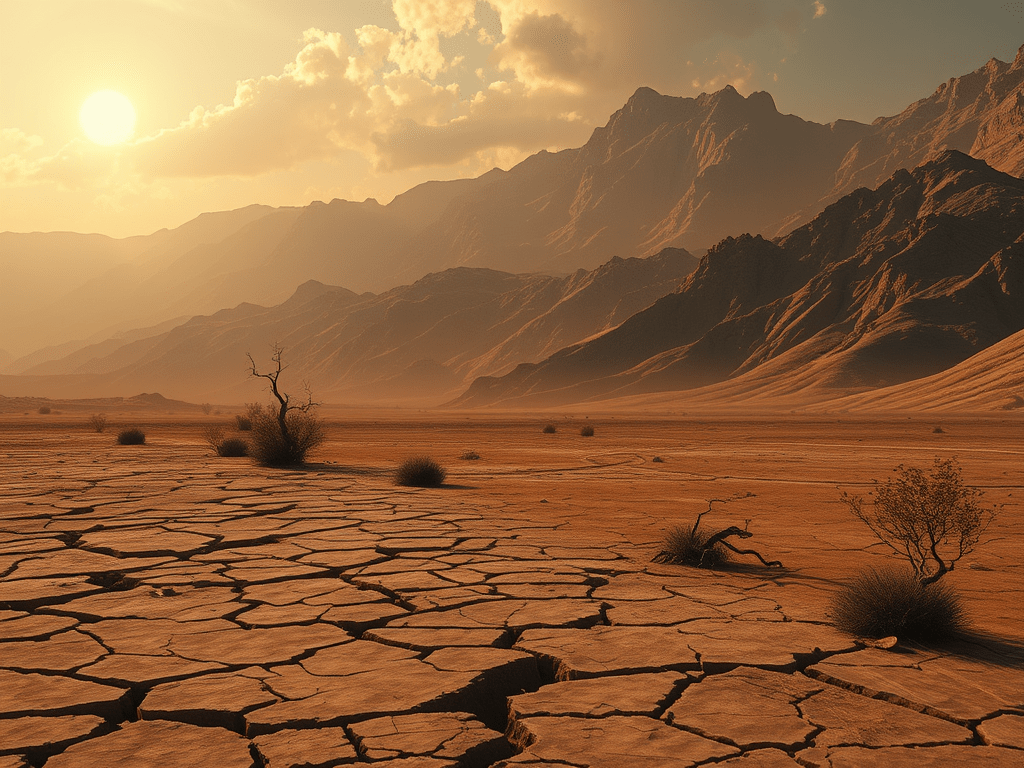
The drought that struck the Indian subcontinent around 2200 BCE had a profound impact on the Seven Rivers Civilization. This event, well documented by climatic and geological studies, had consequences on the environment, economy and culture of this flourishing civilization.
A period of upheaval
The drought led to the gradual drying up of the Sarasvati, which would be completed three centuries later following earthquakes, a river central to the economic and spiritual life of the region. But its repercussions were not limited to water and agriculture: they also affected a crucial element of Vedic spiritual practices, the soma.
The disappearance of soma: a cultural and spiritual loss
Soma, described in Vedic texts as a sacred plant that allows for the expansion of consciousness, played a central role in the rituals and social organization of the Seven Rivers civilization. In all likelihood, this plant was Psilocybe cubensis, an entheogenic mushroom that requires moisture to grow.
As drought set in, the climatic conditions necessary for the growth of soma deteriorated. Within a few generations, this plant probably disappeared from the region, and with it, the spiritual experiences that facilitated the dissolution of the ego and maintained social harmony.
The return of the ego and its consequences
Without the soma, Vedic rituals lost a vital part of their transformative power. In the absence of these direct experiences of expanding consciousness, social and spiritual structures had to evolve. Within three generations, knowledge of the soma and its role was probably forgotten, leading to a gradual return of the ego in society.
The Vedic hymns, which testified to the power of soma, then took on a more symbolic than practical dimension. This change may have redefining the cosmology and spirituality of the civilization of the 7 rivers, marking a transition to a new cultural era.
A legacy that is still present
Despite its disappearance, soma continues to fascinate and inspire. Vedic texts make it an enigma that connects us to a time when spiritual practices were intimately intertwined with the cycles of nature. The drought of 2200 BCE remains a reminder of the impact of climate on civilizations, but also on the spiritual practices that shape their identity.
 Le Rig Veda
Laisser un commentaire