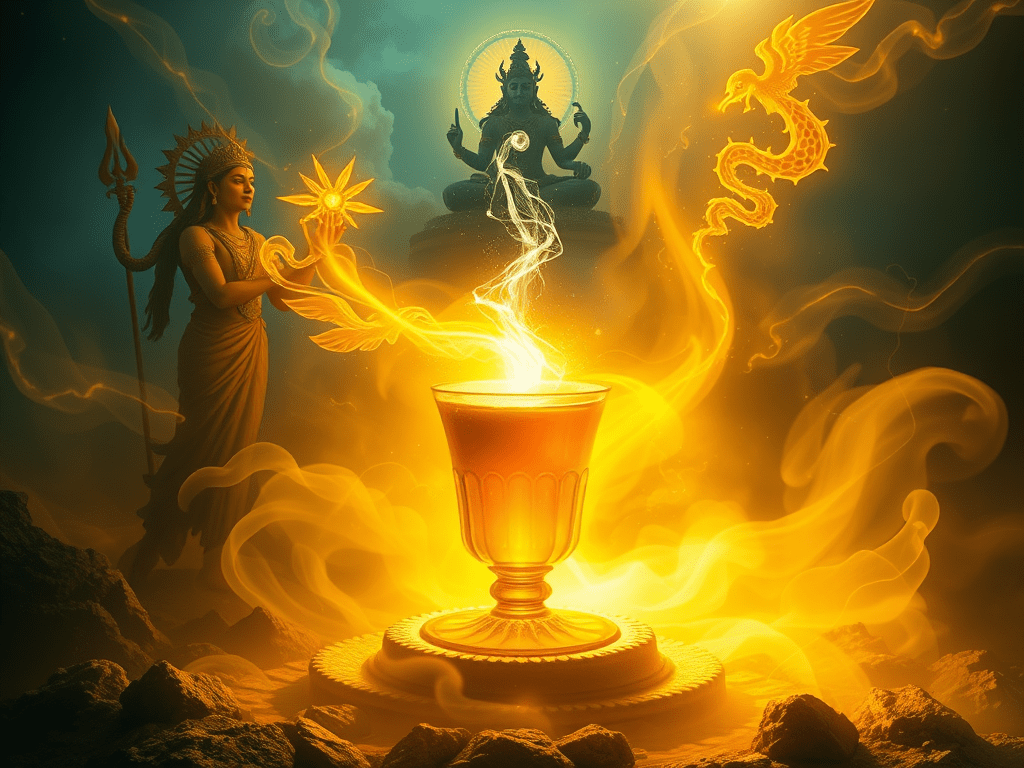
The Rig Veda, a sacred text from ancient India, repeatedly mentions a mysterious substance: Soma . Described as a sacred drink, it was associated with spiritual enlightenment, divine visions and vital energy. However, this substance seems to have disappeared over time. Why? And what were the spiritual consequences for the Vedic traditions?
What is Soma?
In the Rig Veda, Soma is presented as a sacred plant transformed into a ritual drink. It is often mentioned in connection with the gods, notably Indra, the king of the devas, who consumed Soma to strengthen his power before battles.
Soma was praised for its transcendent effects:
- It gave clarity of mind.
- He connected man to the divine.
- It allowed for unique mystical experiences.
The Soma plant has no leaves, seeds, fruits or flowers, and is described as a fiber. According to specialists, it is a mushroom of the psilocybe cubnesis type, containing psilicybin.
Why did Soma disappear?
There are several hypotheses regarding the disappearance of Soma:
- A rare or extinct plant
Some researchers believe that Soma came from a species of plant or fungus that became unobtainable due to the great drought of 2200 BCE that struck the entire intertropical zone of the Earth. - A Symbolic Transition
Over time, Vedic practices evolved as we can see in the Upanishads. Soma, initially physical, could have been reinterpreted as a symbol: the spiritual state sought through meditation or yoga. - A loss of traditional knowledge
The identification of Soma could have been forgotten with oral transmission.
Spiritual transformation induced by disappearance
The disappearance of Soma had a profound impact on Vedic spirituality. Instead of relying on an external substance, practitioners developed internal practices to achieve enlightenment:
- Yoga and meditation
These disciplines have become central to achieving higher states of consciousness. - Mantra Recitations
Vedic chanting and repetition of mantras have taken a more important place in spiritual quest. - The symbolization of rituals
The now unobtainable Soma was incorporated as an idea representing the quest for divine bliss ( amrita ).
A quest that is still relevant today
Today, Soma continues to intrigue researchers, mystics, and spiritual enthusiasts. Some see it as a myth, others as a lost key to understanding ancient practices. But beyond its physical disappearance, Soma represents a timeless lesson: spiritual evolution does not depend on external substances, but on inner transformation.
Conclusion
The disappearance of Soma marked a major transition in Indian spirituality. It pushed the ancients to seek new paths to enlightenment, thus transforming their relationship with the divine. This phenomenon, far from being a loss, enriched the Vedic traditions, making them accessible to all, without the need for material dependence.
 Le Rig Veda
Laisser un commentaire