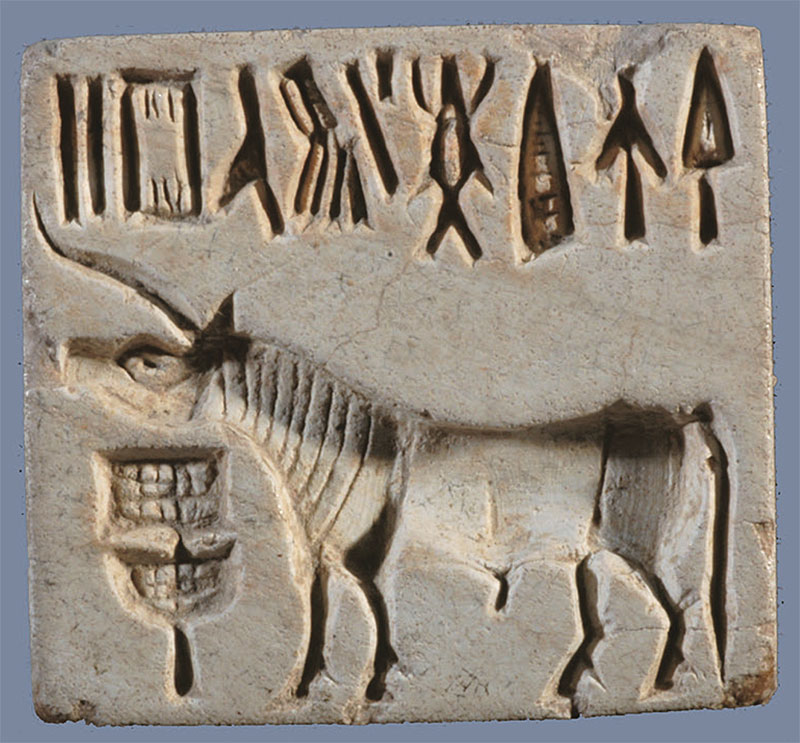
The cities of Sarasvatî, located at the heart of the ancient civilization of the 7 rivers (Indus civilization), conceal fascinating mysteries. Among them, the appearance of the first vestiges of writing. These inscriptions, engraved on seals, pottery and tablets, offer us a glimpse of the exchanges, rituals and social organization of this advanced culture.
What is the Indus-Sarasvatî script?
The writing discovered on the Sarasvatî sites is a series of symbols which is mainly found on:
- Steatite seals , often accompanied by animal motifs such as bulls, elephants and rhinoceroses.
- Pottery , where simpler symbols sometimes appear in series.
- Terracotta tablets , perhaps used for administrative or ritual documents.
These inscriptions are composed of short signs, often between three and five characters, and have not yet been deciphered.
The main sites where these remains were found
- Rakhigarhi
Rakhigarhi, located on ancient Sarasvatî, is one of the largest sites of this civilization. Seals and pottery bearing symbols have been discovered there, confirming that writing played a role in the activities of this city. - Kalibangan
At Kalibangan, signs engraved on pottery and terracotta fragments show that writing was already used to identify or mark objects. - Bhirrana
Considered one of the oldest cities of Sarasvatî, Bhirrana has yielded pottery with rudimentary inscriptions, which could mark the beginning of writing in this region. - Dholavira
Although located somewhat away from Sarasvatî, Dholavira has revealed a monumental terracotta inscription, demonstrating a more elaborate use of signs, perhaps to display important messages.
A writing that is always mysterious
Unlike the writing systems of Mesopotamia or Egypt, the Indus-Sarasvatî script has not yet revealed its secrets. Here are some hypotheses about its use:
- A proto-syllabic or logographic writing , where each symbol represents a word or an idea.
- A system of trade codes , used to identify goods or craftsmen.
- A ritual or symbolic language , used in religious ceremonies.
Despite extensive research, the lack of long texts makes its decipherment difficult.
Why these remains are important
These inscriptions prove that the inhabitants of the cities of Sarasvatî already mastered advanced forms of written communication. Even if their exact function remains uncertain, these signs show an organized society, capable of transmitting information and structuring its interactions.
Conclusion
The earliest written remains in the cities of Sarasvatî bear witness to a rich culture with sophisticated means to manage its rituals and trade. Although their decipherment remains a challenge, these inscriptions constitute a milestone in the history of human writing and continue to captivate scholars around the world.
 Le Rig Veda
Laisser un commentaire