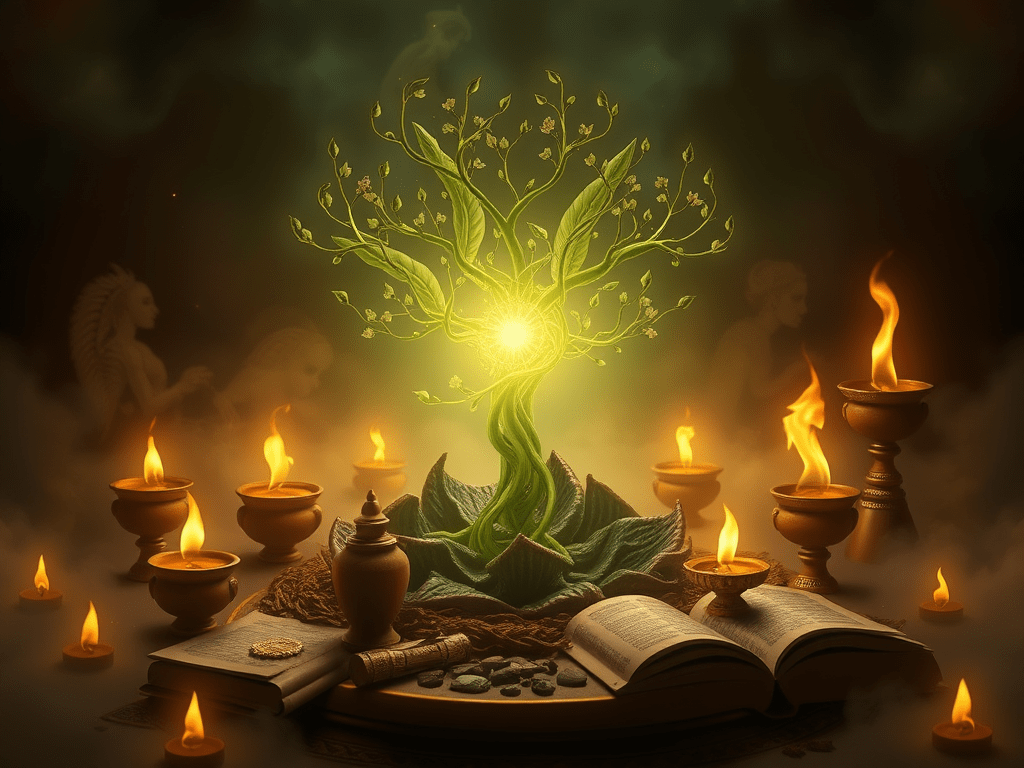
The Rig Veda , a sacred text of the Seven Rivers civilization , highlights a central element of its spiritual rituals: Soma , a sacred plant with transformative effects. Much more than a simple beverage, Soma was at the heart of religious, political and social life. This article explores its role, its entheogenic effects and its impact on a peaceful and prosperous society.
What is Soma in Rig Veda?
Soma is described in the Vedic hymns as a mysterious plant, devoid of leaves, flowers, seeds or fruits. Considered a divine nectar, Soma was prepared into a drink intended to awaken the mind and strengthen the connection with the divine.
Modern researchers, such as Stanislav Grof and Rick Strassman , draw parallels between Vedic descriptions of Soma and entheogenic plants known today, such as psilocybin mushrooms. These natural substances, rich in tryptamines, are recognized for their effects on human consciousness, allowing for profound experiences of spiritual awakening and inner transformation.
Soma: A Key to a Harmonious Society
In the 7 Rivers civilization , the consumption of Soma was not only reserved for priests, but also for leaders. The latter, under the influence of Soma, adopted a disinterested vision, guided by wisdom and benevolence.
The hymns of the Rig Veda describe a peaceful society, without armies or slavery, where cooperation and harmony dominated. Soma played a vital role in this organization, dissolving the egos of leaders and fostering inspired collective decisions.
Vedic rituals around Soma
Rituals involving Soma were not limited to its consumption. They included:
- The careful preparation : The Soma was extracted, filtered and mixed with other sacred elements.
- Vedic chants : Hymns dedicated to Indra (energy and strength), Agni (fire and light) and Ushas (dawn) accompanied these ceremonies.
- Ritual offerings : Soma was offered to the gods before being shared among the participants.
These practices reinforced the unity between man, nature and the divine, while anchoring values of peace and mutual respect.
The entheogenic effects of Soma according to modern researchers
Recent studies on entheogenic substances, conducted by experts such as Rick Strassman and Stanislav Grof, reveal that these plants can induce altered states of consciousness. These states include:
- A dissolution of the ego, promoting a sense of unity.
- An expansion of consciousness, with spiritual visions and intuitions.
- A deep connection with nature and the divine.
These effects explain why Soma was central to the spiritual and political life of the 7 Rivers civilization.
Soma and the prosperity of the 7 rivers civilization
The influence of Soma went far beyond religious rituals. By inspiring wise and altruistic decisions, it contributed to the stability and prosperity of this society. Its use, combined with peaceful collective organization, allowed the civilization of the 7 rivers to flourish without conflict or oppression.
Why the Soma model still inspires today
The role of Soma in the Seven Rivers civilization remains an inspiration. It shows how spiritual practices integrated with governance can create a harmonious society.
Revisiting the Rig Veda and its rituals invites us to reflect on the potential of sacred plants as tools to strengthen peace, consciousness and social cohesion.
 Le Rig Veda
Laisser un commentaire