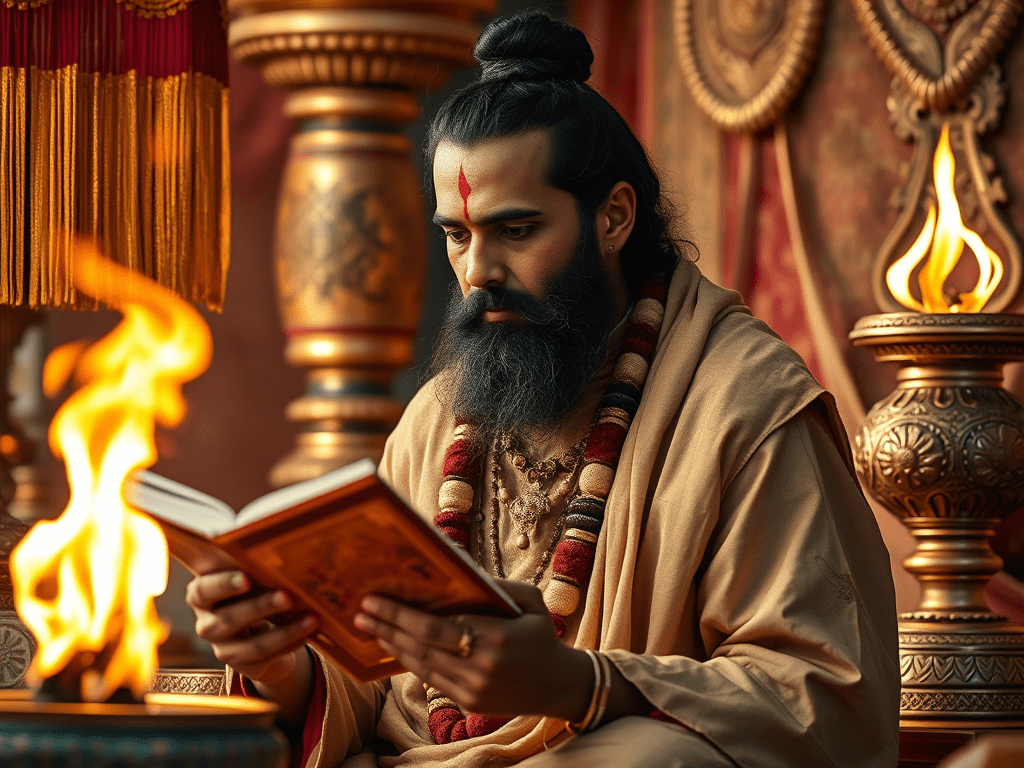
In the Vedic texts of ancient India, priests play a central role in rituals and the preservation of tradition. Their importance lies in two main missions: the conduct of rituals and the faithful transmission of sacred knowledge.
1. Priests, guides of sacred rituals
Vedic rituals were complex and required precise execution to honor the gods. Priests were the experts in these ceremonies. They recited hymns from the Vedas, sacred texts considered eternal and of divine origin.
These rituals served several purposes:
– Pray for material and spiritual prosperity: to obtain abundant harvests, rain, victory or Enlightenment.
– Maintaining cosmic order: balancing the forces of nature through offerings and elevating oneself spiritually.
– Strengthen the bonds between humans and deities to attain Brahman.
Each priest had a specific role according to his specialization:
– The Hotar: he sang the hymns of the Rig Veda.
– The Adhvaryu: he performed the gestures and sacrifices.
– The Udgatar: he sang the melodies of the Sama Veda.
– The Brahman: he supervised the ritual and corrected errors.
2. Oral transmission of knowledge
In the Vedic period, there was no writing. Knowledge was transmitted orally, with impressive precision. Priests memorized thousands of verses and taught them to their students by repetition. This method of oral transmission ensured that the sacred texts were preserved intact for centuries.
To ensure this loyalty, they used techniques such as:
– Collective recitation: singing in a group to correct mistakes.
– Rhythmic patterns: repeat with a specific rhythm to memorize better.
– Codified variations: recite a text by modulating it to check each word.
3. Preserve spiritual traditions
Beyond rituals, Vedic priests played a crucial role in cultural and spiritual continuity. By transmitting the teachings of the Vedas, they ensured not only the preservation of the texts, but also the values and practices associated with Vedic society.
They also taught kings and householders, showing them how to rule in accordance with dharma (moral order). This combination of spirituality and social duty made priests essential figures in Vedic society.
Conclusion
The role of the priest in Vedic rituals goes beyond the mere performance of ceremonies. By preserving and orally transmitting the Vedas, they helped to maintain a living tradition that still influences Indian spirituality today. Their work was an exceptional dedication to learning and collective memory.
 Le Rig Veda
Laisser un commentaire