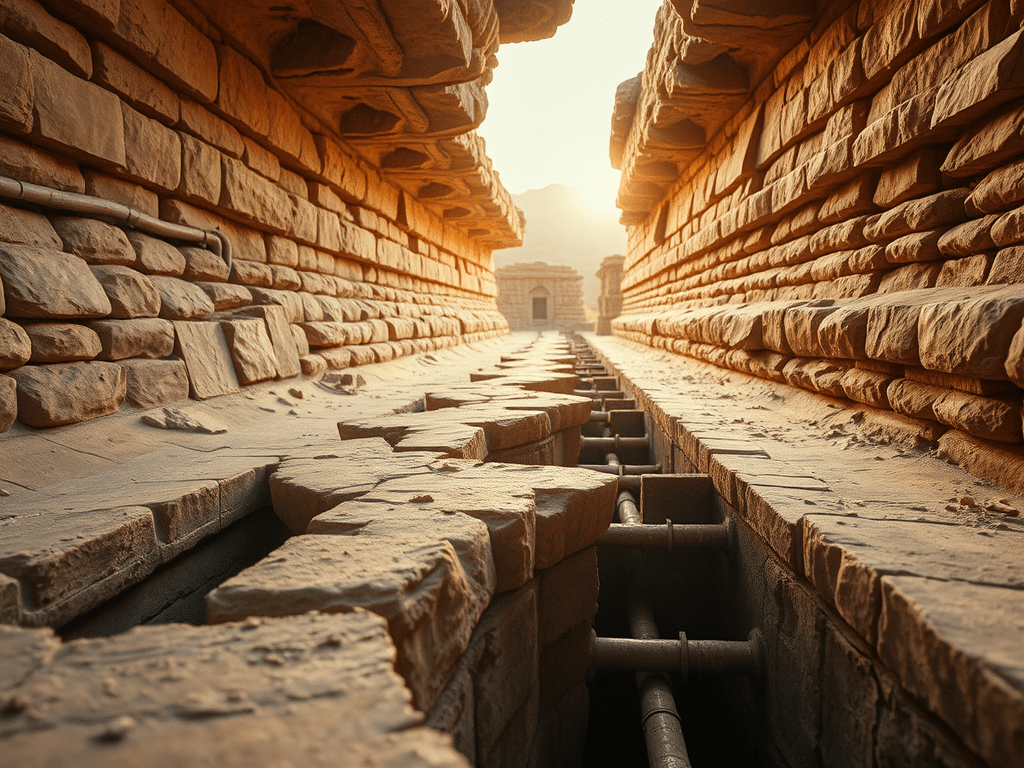
The Seven Rivers Civilization, also known as the Indus-Sarasvati Civilization, has made history with its advances in urban planning. The cities of Rakhigarhi and Mohenjo-daro, among the largest and most impressive, are striking examples of the ingenuity of this civilization in wastewater management and drainage. These two cities, although separated by hundreds of kilometers, share similarities while showing particularities in their infrastructures.
1. Rakhigarhi: a simple and effective system
Rakhigarhi, one of the oldest and largest cities of this civilization, was located on the banks of the Sarasvati River. Excavations have revealed that the city had an organized drainage system, designed to carry away waste water efficiently. The drains of Rakhigarhi were made of terracotta and stretched along the main streets. These drains passed under the houses and joined in larger collectors which in turn carried the water to ponds located outside the city.
The Rakhigarhi system seems simpler compared to that of Mohenjo-daro, but it was ingenious for its time and suited to the needs of the city. The canals were designed to minimise obstructions and ensure smooth flow of waste water. This shows that even with a modest infrastructure, Rakhigarhi already had mastered water management techniques to ensure optimum hygiene in an urban environment.
2. Mohenjo-daro: a complex and organized network
Mohenjo-daro, the other major city of the Seven Rivers Civilization, impresses with the complexity of its drainage network. Situated further south, this city is often considered a model of urban planning for the time. At Mohenjo-daro, the drainage systems were much more elaborate and extensive than those of Rakhigarhi.
Each house was connected to a system of underground pipes, and waste water was directed to larger collectors that ran along the streets. The drains were made of baked bricks and were regularly covered to prevent waste from clogging them. This system also prevented bad smells and allowed residents to move around the streets without hindrance. The fact that the drains were covered shows attention to detail and concern for the well-being of the residents.
Another strong point of the Mohenjo-daro system is the presence of wastewater tanks at various locations in the city. These tanks allowed water to be stored for a certain period of time before being discharged outside the city, thereby reducing the risk of contamination.
3. Comparison and shared innovations
The drainage systems of Rakhigarhi and Mohenjo-daro show the advances of the 7 rivers civilization in the field of wastewater management. Although the network of Mohenjo-daro is more developed and sophisticated, both cities shared a common vision of urban planning, where hygiene and comfort of the inhabitants were essential.
What is striking about both cities is the attention paid to cleanliness. In both cases, drains are often located under the main streets and benefit from support structures made of terracotta or baked bricks, depending on local resources. The choice of materials was probably influenced by the resources available and the specific needs of each city.
4. Legacy of the 7 Rivers Civilization
Comparing the drainage systems of Rakhigarhi and Mohenjo-daro reminds us that the Seven Rivers Civilization was one of the first to address urban sanitation on a large scale. This attention to wastewater management probably contributed to the longevity and prosperity of these cities.
Today, these systems are studied for their ingenuity and efficiency, testifying to a society that understood the importance of water and sanitation for the well-being of its inhabitants.
 Le Rig Veda
Laisser un commentaire