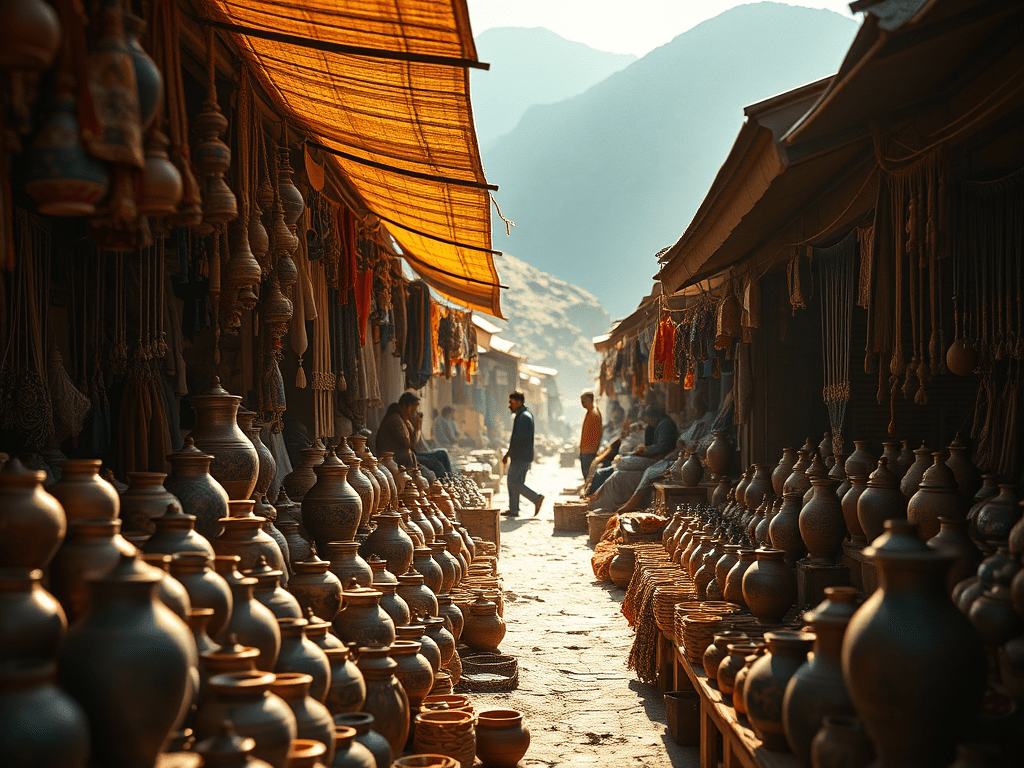
The civilization of the 7 rivers, centered around the Indus and Sarasvati valleys, developed with prosperous and well-organized cities. In parallel, in the region of Baluchistan, today in Afghanistan and Pakistan, more modest but strategic cities also flourished. These two areas, separated by mountains, maintained commercial, cultural and technological links that enriched both regions.
Significant trade exchanges
The towns along the Sarasvati,like Rakhigarhi and Kalibangan, were well established, with good infrastructure. Their trade extended to the cities of Balochistan. The region is known to have possessed natural resources, including precious stones, minerals and products specific to the mountainous terrain, such as lapis lazuli. The inhabitants of the towns along the Sarasvati were very fond of these rare materials, which were used to make jewellery, seals and other precious objects.
Exchanges were not limited to material goods. Trade also allowed the circulation of ideas and know-how. For example, the metallurgy and pottery of the two regions show similarities that suggest transfers of techniques. This resulted in the adoption of similar styles and motifs, while respecting the particularities of each region.
Trade routes: a vital link
Trade routes connecting Sarasvati and Balochistan were essential to the region’s economy and communication. These routes passed through mountain passes and valleys, allowing merchants to transport goods between cities. Some cities in Balochistan, like Mundigak, served as staging posts for trade caravans, facilitating trade with urban centers in Sarasvati.
The Sarasvati towns, with their bustling markets and networks of artisans, welcomed products and ideas from Balochistan, contributing to shared prosperity. Baloch artifacts,like distinctively patterned pottery and lapis lazuli beads, are found in Sarasvati towns, reflecting this constant interaction between the two regions.
A cultural and social impact
The exchanges between Sarasvati and Baluchistan had a profound impact on the societies of the Seven Rivers Civilization. Religious practices, symbols and even some social customs seem to have been influenced by this interaction. For example, the motifs of some seals found in the cities of Sarasvati, with representations of animals or mythological figures, recall symbols used in Baluchistan.
This contact also fostered mutual understanding between cultures, allowing people from each region to adopt practices that were beneficial to them. The resulting cultural openness enriched the traditions of both regions, creating an environment of respect and admiration.
The challenges of regional interactions
Despite this shared prosperity, interactions between Sarasvati and Balochistan were not without challenges. Travel through the mountains was risky, and caravans had to navigate harsh natural conditions,like the arid climate and steep terrain. Moreover, linguistic and cultural differences sometimes complicated exchanges. Yet, the benefits seemed to outweigh these obstacles, as trade and cultural contacts continued for centuries.
Conclusion
The interaction between the cities of Sarasvati and the cities of Baluchistan enriched the civilization of the 7 rivers, contributing to its economic and cultural development. The exchange of goods, techniques and knowledge allowed the two regions to prosper and influence each other, creating a shared history within this thousand-year-old civilization.
 Le Rig Veda
Laisser un commentaire