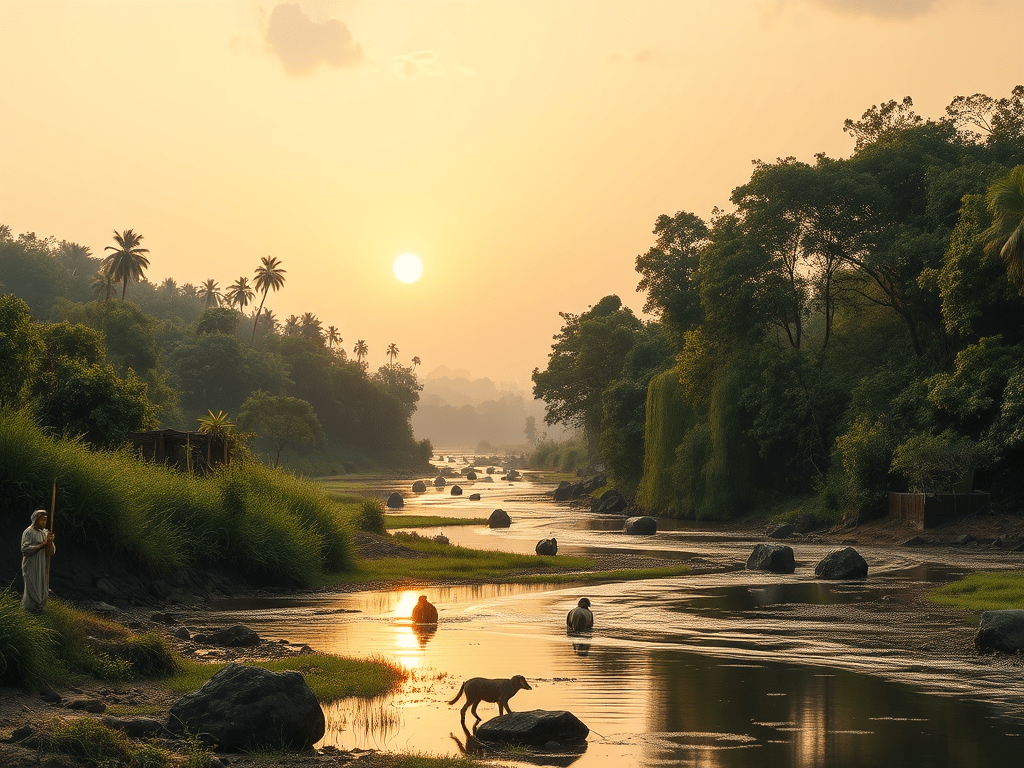
The Tenth Mandala of the Rig Veda is a fascinating collection of hymns, showing us a complex society in full spiritual and material evolution, around 2200 BCE. At this time, the civilization of the 7 rivers (Indus civilization) underwent many changes, including a shortage of soma, this sacred plant which played a central role in spiritual rituals.
The End of Soma Abundance
Soma was central to spiritual practices and ceremonies, believed to bring visions and divine connection. However, around 2200 BCE, it became increasingly scarce due to a severe drought that struck the entire intertropical zone of the planet. This shortage marked a real transition in religious traditions: without soma, society began to turn more towards practical prayers and rituals designed to improve daily life.
Concrete Hymns, Close to Life
The spiritual evolution of the ancient Indians is no longer limited to invocations to the gods and songs of soul elevation. Many hymns in the tenth Mandala show a very concrete approach to life. Some hymns, for example, ask for fertility, addressed to people who wish to conceive a child. Others speak of illnesses and pray for health, a sign that earthly life now occupies an important place in the concerns of men.
There are also hymns about marriage, family and clan continuity, which show that society now valued social organization and the material well-being of its members. This diversity of hymns illustrates the transformation of a society in search of stability, both spiritually and materially.
The Hymns of Creation, Rivers and Castes
Despite these practical hymns, the tenth Mandala also preserves profound texts, which reveal larger questions about existence. One of the most famous hymns is that of the creation of the world. It asks fundamental philosophical questions: how did the universe come into being? Was it created by a god? This text, known as the Nasadiya Sukta, is a hymn on the origin of life and the very essence of existence, with great humility in the face of the mysteries of creation.
The Hymn to the Rivers is also central, as it gives a description of the geography of this civilization. It cites the great rivers of the region, notably the Sarasvati, which occupies a central place in the life and imagination of this civilization. These rivers, nourishing and sacred, are seen as goddesses bringing prosperity and fertility to the populations. The hymn also shows the importance of geography for the civilization of the 7 rivers, linking the inhabited lands and their economic activities to the sacred waters.
Moreover, some hymns address for the first time ideas related to caste, or varnas, an emerging concept that structures society into different categories. These hymns do not yet present a rigid system, but they already reveal a social hierarchy based on the different activities and responsibilities of individuals within the community.
A Mandala of Transformation and Human Realities
The tenth Mandala of the Rig Veda thus shows us a society in transition, where spiritual practices and material concerns are mixed. The shortage of soma pushed the ancient inhabitants of the civilization of the 7 rivers to reorient their faith and prayers towards more practical aspects of life. Through these hymns, we observe human aspirations, health, prosperity, and the understanding of the world and the emerging castes.
This Mandala, in its diversity, is a faithful mirror of this era: a world in search of answers, seeking to reconcile the spiritual and the material, the celestial and the terrestrial, at a key moment in its history.
 Le Rig Veda
Laisser un commentaire