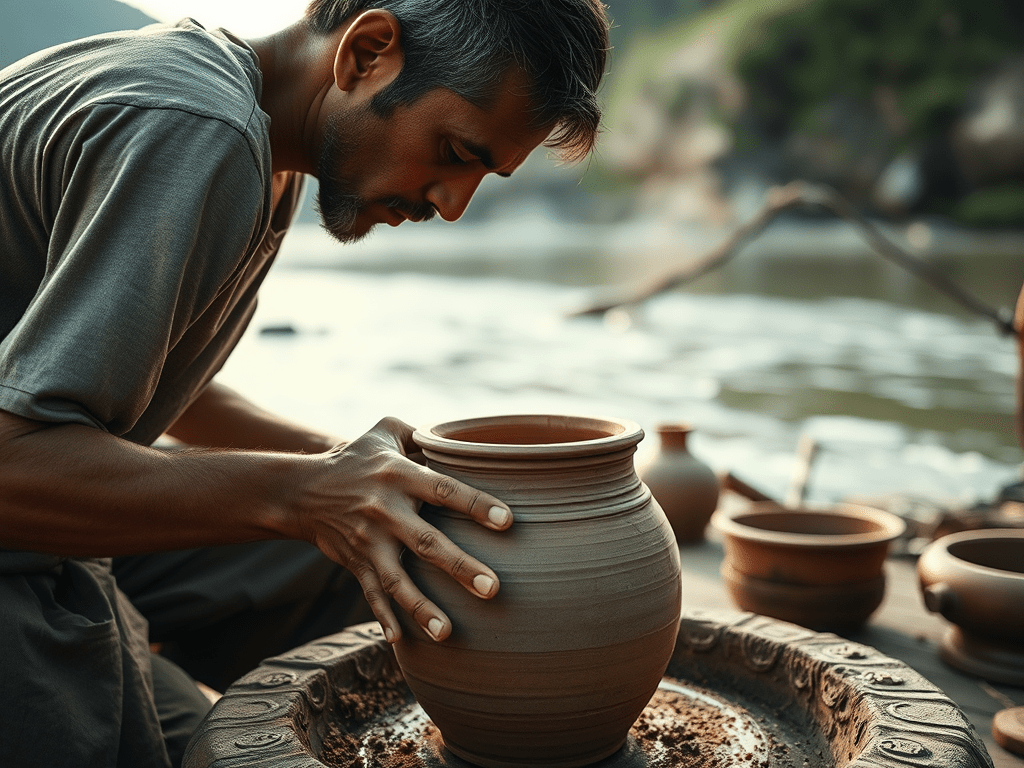
Kalibangan, one of the major cities of the Indus-Sarasvati civilization, is renowned for its innovations in urban planning, but also for its crafts, especially pottery. Situated on the banks of the ancient Sarasvati River, Kalibangan offers a fascinating glimpse into the craftsmanship of the time. Pottery occupied an essential place in the daily lives of its inhabitants, both for domestic and ritual use.
1. Pottery making
Pottery at Kalibangan was mainly made by hand, although wheel-thrown pottery has also been found, indicating some mastery of the potter’s wheel technique. The main material was clay, probably collected along the banks of the Sarasvati. The potters of Kalibangan were skilled in shaping different shapes of vessels for various uses: jars for storing grains, bowls for eating, and pots for carrying water.
2. Decoration and patterns
Kalibangan pottery was often decorated with simple geometric patterns. There were lines, circles, zigzag patterns, but also symbols in the shape of leaves or animals. These designs were made using natural paints, often red or black, which resisted firing well.
3. The cooking technique
One of the keys to Kalibangan pottery was the firing technique. Potters used wood-fired kilns to fire the pieces. These kilns could reach temperatures high enough to produce strong, durable pottery. Well-controlled firing resulted in quality pieces that were hard-wearing and suitable for everyday use or spiritual practices.
4. The importance of pottery in daily life
Pottery was an integral part of the daily lives of the people of Kalibangan. Jars and pots were used to store water, store grain, or transport goods. Pottery objects also played a role in spiritual practices, as can be seen from some pieces found at excavation sites that appear to have been intended for offerings.
5. Transmission of know-how
Pottery techniques in Kalibangan were probably passed down from generation to generation. This shows a well-established craft, where potters perfected their skills over the years, drawing on ancient traditions.
—
In summary, the pottery in Kalibangan shows how central this craft was to the life of the 7 Rivers civilization. Through mastered techniques and a rich artistic tradition, potters helped shape part of the identity of this great civilization, while meeting the practical and spiritual needs of its inhabitants.
 Le Rig Veda
Laisser un commentaire