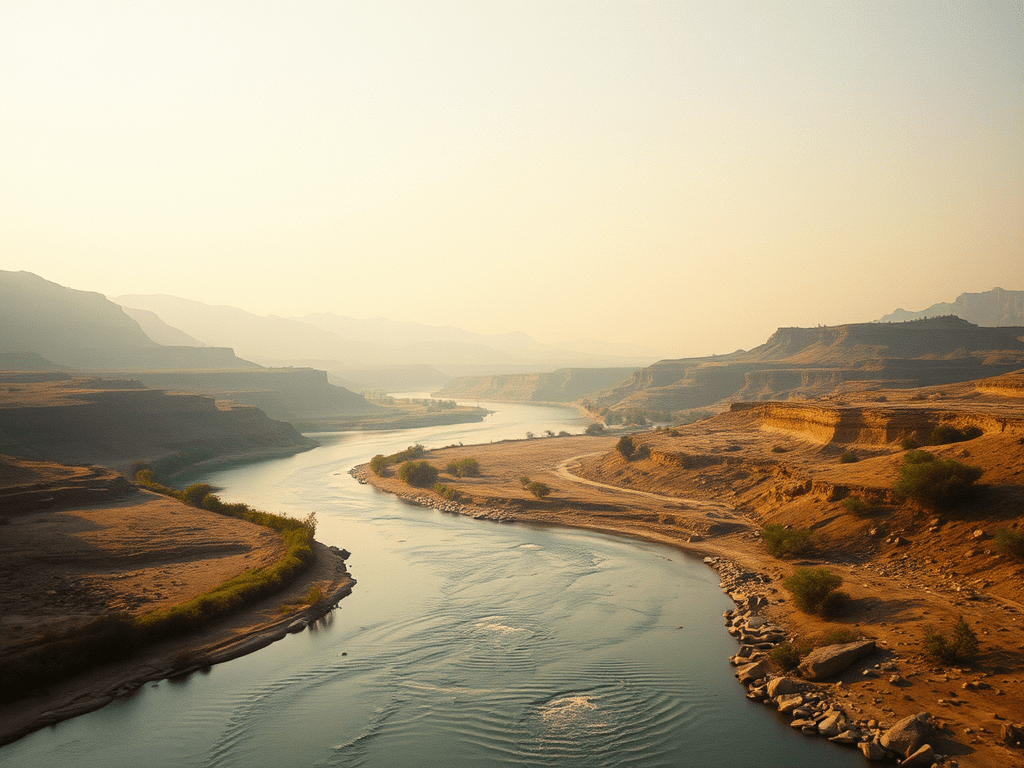
The Sarasvati, mentioned in the Vedic texts as a mighty river, played a central role in the Indus civilization, also called the « civilization of the seven rivers ». This now extinct river once flowed for hundreds of kilometers and crossed the regions of present-day northwestern India and Pakistan. It was much more than just a source of water: it represented the spiritual and material life of the people of the Indus.
An essential resource for agriculture and trade
The Sarasvati River was a backbone of the economy of this civilization. Large cities like Harappa and Mohenjo-Daro depended on water for agriculture. The river was used to irrigate the land and grow cereals, vegetables and other food resources. The inhabitants used ingenious techniques to channel the water and make sure that they had enough resources in all seasons.
Besides nourishing the fields, the Sarasvati facilitated trade between cities. Important trade routes ran along its course, connecting the Indus civilization to neighboring regions, like Mesopotamia. This trade allowed the civilization to flourish and exchange goods like metals, precious stones, and pottery.
A sacred river in Vedic culture
But the Sarasvati was not just a physical river. It also had great religious and spiritual significance. In the hymns of the Rig Veda, it is celebrated as a goddess, a divine force that brings prosperity and knowledge. For the people of the Indus, the river was not only a resource, but also a symbol of purification and transformation. Water rituals and offerings to the river reinforced this idea that the Sarasvati was a gateway to spiritual enlightenment.
The Decline of Sarasvati and its Impact on Civilization
Around 1900 BCE, the Sarasvati River began to dry up, probably due to climatic changes and tectonic movements. This caused large migrations of people from the Indus to other regions. The decline of the Sarasvati thus marked a major transformation for this civilization. Some cities were abandoned, while others survived by reorienting themselves towards other rivers like the Indus or the Ganges.
Conclusion
The Sarasvati was much more than a river to the Indus civilization. It was a vital force, both material and spiritual, that supported agriculture, trade, and religious culture. Its importance is such that, even after its disappearance, it continues to influence beliefs and narratives in Hindu traditions to this day.
 Le Rig Veda
Laisser un commentaire