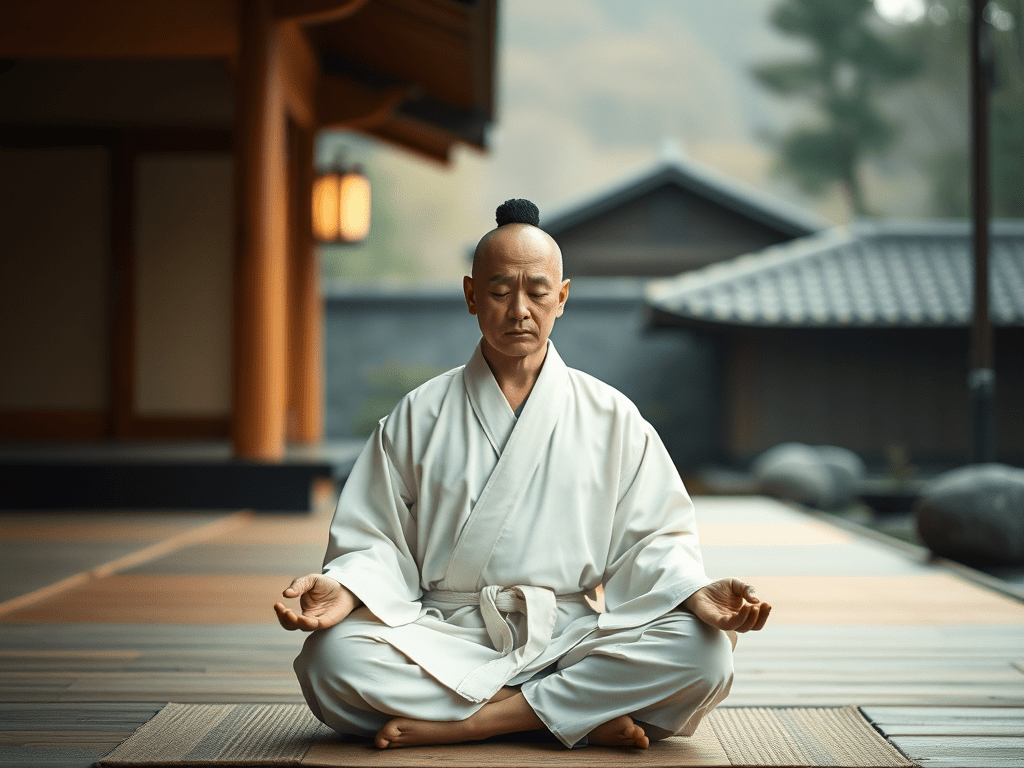
Zen meditation, or Zazen, is at the heart of Japanese Zen Buddhism. It is distinguished by its simplicity and direct approach to enlightenment. The goal of Zazen is to quiet the mind to allow immediate perception of the deeper nature of reality, called « Satori, » or instant enlightenment.
Essential practices
1. Zazen (Silent sitting)
Zazen is the main practice of Zen. It consists of sitting in the lotus or half-lotus posture, with the back straight, the hands placed in mudra (gesture of concentration) on the knees. Attention is focused on breathing, which becomes an anchor point for the mind. This practice aims to develop deep, effortless concentration, allowing one to perceive the emptiness of all thought or emotion.
2. Kōan (Zen Riddles)
Kōan are paradoxical questions or stories without a rational answer. For example, « What is the sound of one hand clapping? » They are used to transcend intellectual logic and break habitual mental patterns. Solving a Kōan can cause a flash of understanding, leading to instant enlightenment.
3. Shikantaza (Just Sit)
This form of meditation does not focus on anything in particular. Unlike Zazen, where the attention is on the breath, in Shikantaza the goal is simply to sit, without expectation or goal. It is a total opening to the present moment, where enlightenment can arise spontaneously.
4. Samu (Meditative work)
Zen integrates meditation into daily activities. Samu refers to simple tasks such as sweeping or gardening, performed with full awareness. This work allows one to remain anchored in the present, transforming each action into an opportunity for accomplishment.
The principle of instant illumination
Unlike other traditions that view enlightenment as a long path, Zen teaches that enlightenment is always accessible, here and now. Through direct practices such as Zazen or Kōan, the practitioner seeks to pierce the nature of the world in an instant, without accumulation of effort. This vision is based on the idea that the essence of the mind is already enlightened, and that it is enough to remove the mental veils to realize it.
In conclusion, Zen meditation in Japan offers a direct and purified approach to achieving enlightenment. Through the discipline of sitting, the use of Kōan or simply performing daily tasks in full awareness, the individual can experience an instant awakening to his or her true nature.
 Le Rig Veda
Laisser un commentaire