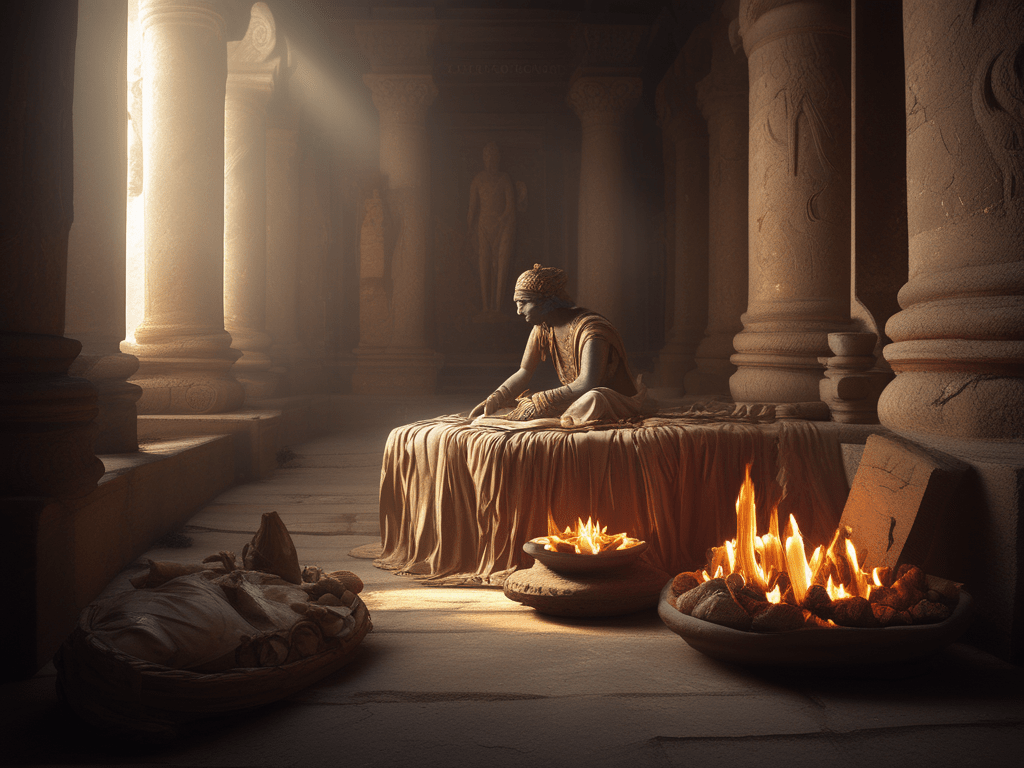
The Eleusinian Mysteries were sacred rites celebrated in ancient Greece, centered on the goddess Demeter and her daughter Persephone. These rites, among the most important in the Greek religion, took place in Eleusis, near Athens. The Mysteries offered a unique spiritual experience, allowing initiates to explore deep aspects of human consciousness.
Initiation into the Eleusinian Mysteries took place in several stages, including secret rituals, fasts and processions. One of the key stages was the revelation of sacred objects, believed to provide a deeper understanding of life, death and rebirth. The participants sought an inner transformation, a communion with the divine.
The popularity of the Mysteries extended beyond Greece, attracting people from all over the Mediterranean basin. This spiritual practice offered a sense of belonging to something greater, reinforcing the idea of an afterlife and giving deeper meaning to human existence.
The Eleusinian Mysteries bear intriguing similarities to certain Vedic practices described in the Rig Veda, one of the oldest sacred texts in Hinduism. In both traditions, we find the idea of hidden knowledge, accessible only through initiatory rites. As in the Eleusinian Mysteries, where initiates accessed a profound truth about life and death, the Rig Veda evokes hymns and rituals which allow one to enter into contact with the divine and understand the mysteries of existence.
Another parallel lies in the use of sacred substances to bring about an expansion of consciousness. In the Eleusinian context, we often speak of « kykeon », a ritual drink consumed during ceremonies, while in the Rig Veda, « soma », an entheogenic plant transformed into a drink, is mentioned as a means of accessing higher states of consciousness. These practices suggest a common search for transcendence, linking the two cultures through similar ritual and mystical approaches.
Thus, although separated by geographical and cultural distances, the Eleusinian Mysteries and the Vedic traditions share themes and practices that demonstrate a universal quest for understanding and union with the divine.
 Le Rig Veda
Laisser un commentaire