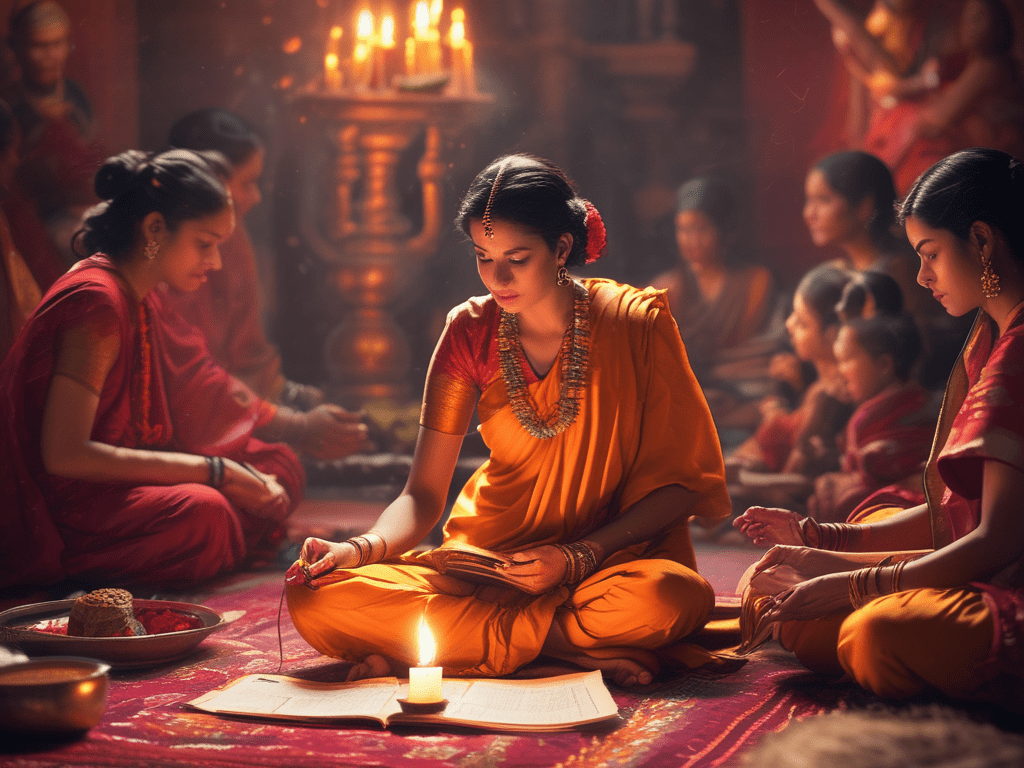
The Role of Women in Vedic Society
In Vedic society, which extends from approximately 3500 to 500 BCE in India, women played a crucial role of respect and responsibility. Vedic culture, based on sacred texts called the Vedas, accorded an important place to women, although their status evolved over time.
1. Education and Knowledge
Women had access to education, a fundamental right in Vedic society. They could study the Vedas, and some, called Rishikas or Brahmavadinis, were recognized as scholars and poets. Figures like Lopamudrâ and Gargî are famous for their philosophical and spiritual contributions. Women were encouraged to participate in intellectual and religious debates, demonstrating recognition of their knowledge.
2. Family and Social Life
Women played a central role in family life. They were the guardians of the home (the Grihastha), responsible for the education of children and the maintenance of family rituals. They also played a role in the management of domestic resources, and their opinion was respected in important decisions.
In marriage, equality and mutual respect were encouraged. Women actively participated in religious rituals alongside their husbands, and it was common for young girls to marry after receiving adequate education, a concept called Kanya-Daan.
3. Economic Participation and Rights
Women had certain economic rights, particularly in matters of property. They could inherit property and had the right to own and manage property. In addition, they contributed to the family economy through their work, whether in agriculture, crafts or other domestic activities.
Spirituality and Religion
Spirituality occupied an important place in the lives of Vedic women. They were active in the practice of rituals and religious ceremonies. Some women became Sadhvis (ascetics) or renounced worldly life to devote themselves entirely to spirituality. Their participation in rituals, such as the Soma Yajna, was considered essential.
Conclusion: A Society of Respect and Duties
In Vedic society, women were pillars of the family and community, enjoying respect and rights in various areas. However, it is important to note that this status has evolved over the centuries, with periods of regression. Vedic society, with its values of education, mutual respect and spirituality, presents a model where women occupied a central place, although not free from limitations.
This picture of Vedic society reveals a vision where women were both protectors of the home, scholars and spiritual figures, demonstrating a diversity of roles that were essential to the balance of the community.
 Le Rig Veda
Laisser un commentaire