The 7 Rivers Civilization, commonly known as the Indus Civilization, is one of the oldest and most mysterious civilizations in the world, dating from approximately 3500 to 1900 BCE. Located in the Indus and Sarasvati valleys, it extended mainly over what is today Pakistan and northwest India. Although this civilization is famous for its urban and technological achievements, its spiritual and religious beliefs remain shrouded in mystery. However, several clues suggest that their spiritual practices may be the origin of Hinduism, one of the world’s oldest religions.
Absence of Temples and Religious Manifestations
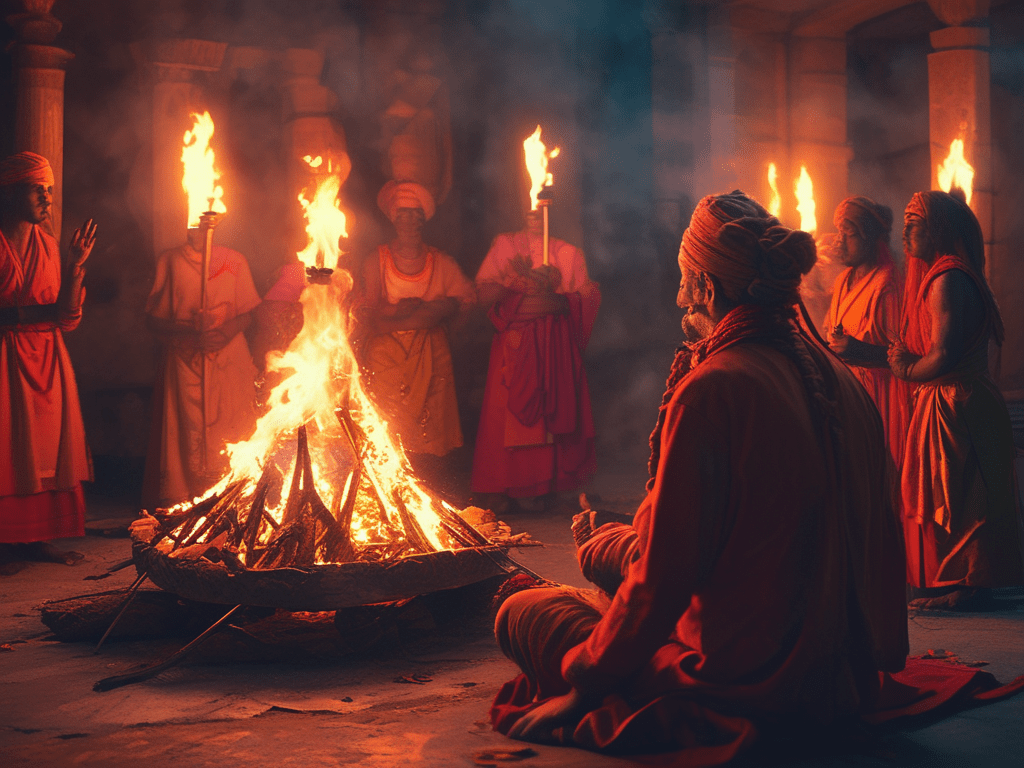
One of the most intriguing aspects of the 7 Rivers civilization is the absence of monumental temples or shrines in the archaeological remains. Unlike other contemporary civilizations, such as the Egyptians or Mesopotamians, who left behind large religious structures, the inhabitants of the Indus seem to have practiced a more discreet religion or spirituality, without temples. This absence does not mean a lack of religiosity, but rather a form of spirituality. Vedic sacrifices took place in the wilderness and did not require a temple.
Indices of Spiritual Beliefs
Although the absence of temples is striking, several artifacts discovered in the Indus Valley provide clues to their spiritual beliefs. Particularly revealing are Indus seals, small soapstone objects engraved with symbols and representations. On several of these seals, we find representations of figures seated in a meditation posture, often identified as yogis. This posture, close to the lotus position in yoga, suggests a spiritual practice which could be a precursor of modern yoga.
Additionally, the pipal leaf, a sacred symbol in Hinduism, appears frequently in Indus iconography. The pipal tree is still venerated in India today, associated with the divinity Vishnu, and this symbolic continuity reinforces the idea of a connection between the beliefs of the 7 Rivers civilization and Hinduism.
The Transition to Hinduism
Several scholars have hypothesized that the religion practiced by the people of Indus evolved and became integrated into Hinduism. The figures found on the seals, like those of the yogis, recall the concepts of dhyana (meditation) and tapas (asceticism) present in Hinduism. The absence of temples could also be explained simply by the fact that Vedic sacrifices took place in the countryside and not in cities.
The Rig Veda: A Sacred Oral Text
To conclude, it is essential to note that the religious beliefs of the 7 Rivers civilization may have been preserved through the Rig Veda, one of the oldest sacred texts in Hinduism. Although the Rig Veda was recorded in writing long after the disappearance of the Indus civilization, it was transmitted orally for millennia. This text, composed of hymns and poems, recounts mythical and historical events that occurred several thousand years ago. Much like the Bible for Christians, the Rig Veda has served as a spiritual and historical guide, connecting the ancient inhabitants of the Indus Valley with religious practices that still remain in India today.
Thus, the civilization of the 7 Rivers, although mysterious, seems to have laid the foundations of a spirituality which has been perpetuated through the ages, profoundly influencing the religious culture of contemporary India. The spiritual practices of this ancient civilization continue to intrigue researchers and believers, hinting at a deep connection between the past and the present.
 Le Rig Veda
Laisser un commentaire