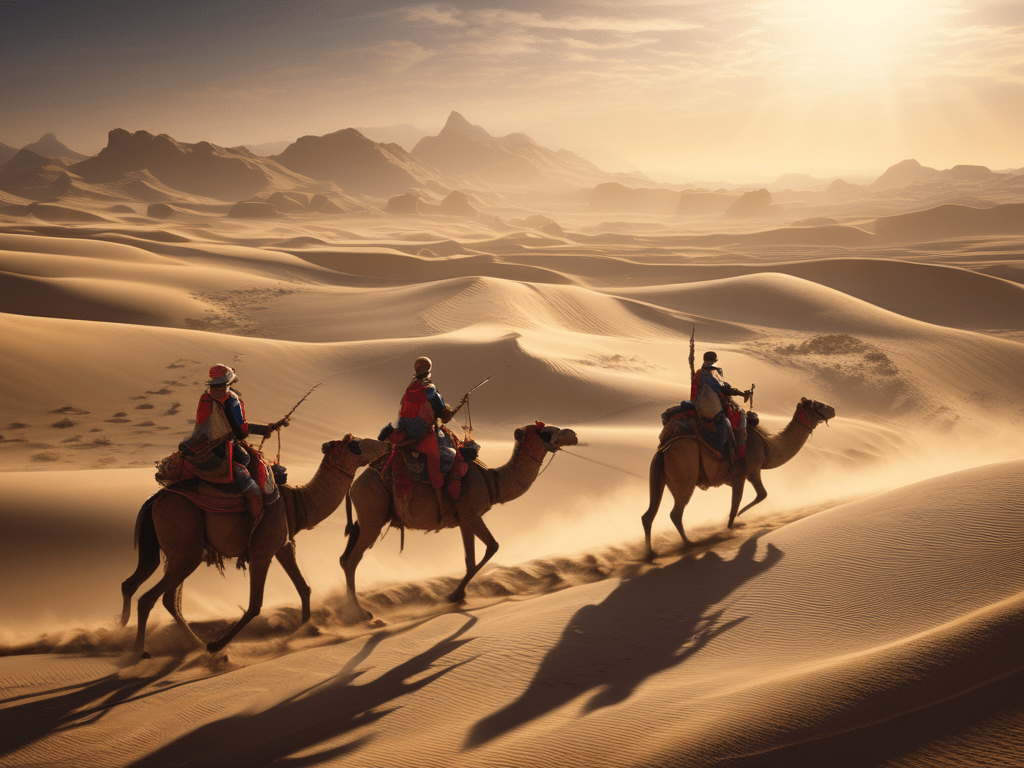
The Oxus Civilization, also called the Bactria-Margiana Civilization, flourished between 2300 and 1700 BCE. Located in what is now Turkmenistan, Uzbekistan, and Afghanistan, it was at the heart of a vital trade network linking East and West.
The Oxus Routes
The people of Oxus used land and river trade routes to exchange goods. Camel caravans roamed the deserts and mountains, transporting goods like precious metals, stone, and textiles. Rivers, notably the Oxus (today called Amu Darya), were crucial arteries for the transport of heavy and bulky goods.
Exchanged Products
The objects found in archaeological excavations show a diversity of exchanged goods. There are jewelry, tools, ceramics and stone objects. These exchanges were not only commercial but also cultural, promoting the exchange of ideas and technologies between civilizations.
The Civilization of the 7 Rivers
Also known as the Indus Civilization, the 7 Rivers Civilization extended along the Indus and Saraswati river valleys, covering much of present-day Pakistan and western India. This civilization, which flourished from 3500 to 1900 BCE, is famous for its well-planned cities like Harappa and Mohenjo-Daro.
Links with Oxus
Trade between the Oxus and the 7 Rivers Civilization was frequent and mutually beneficial. Oxus products, such as lapis lazuli and metals, were highly prized in the Indus Valley. In return, the Oxus received agricultural products, textiles and handicrafts from the 7 Rivers civilization.
Influence and Legacy
Trade has shaped the cultures of both civilizations. We find stylistic influences of the Oxus in the jewelry and objects of art of the civilization of the 7 rivers, and vice versa. These interactions also allowed the sharing of technologies, such as irrigation and metallurgy.
In short, the trade and exchange routes of the Oxus played an important role in the development of these two great civilizations. The exchanges of goods and knowledge have enriched their respective cultures and left a lasting legacy in the history of humanity.
 Le Rig Veda
Laisser un commentaire