Introduction
The 7 Rivers Civilization, also known as the Indus Civilization, flourished from 3500 to 1900 BCE in the river valleys of the Indus and Ghaggar-Hakra (the Sarasvatî), covering part of present-day Pakistan and North-West India. This vast network of cities saw the emergence of complex and evolving social structures, influenced by various cultural, economic and environmental factors. One of the most intriguing aspects of this civilization is the evolution of its social hierarchy, particularly marked by a significant change around 2200 BCE, linked to the use and disappearance of the soma.
Society before 2200 BCE: An Egalitarian Hierarchy
Before 2200 BCE, the society of the 7 Rivers Civilization appears to have been remarkably egalitarian compared to other contemporary civilizations. Archaeological evidence indicates a notable absence of royal palaces or tombs, suggesting a society without tyrannical rulers or rigid social classes. Soma, a sacred ritual substance mentioned in Vedic texts, played a crucial role in maintaining this balance. Consumed during religious ceremonies, soma was renowned for its psychotropic effects, inducing altered states of consciousness that could dissolve the egos of leaders and participants, thereby fostering a culture of sharing and equality.
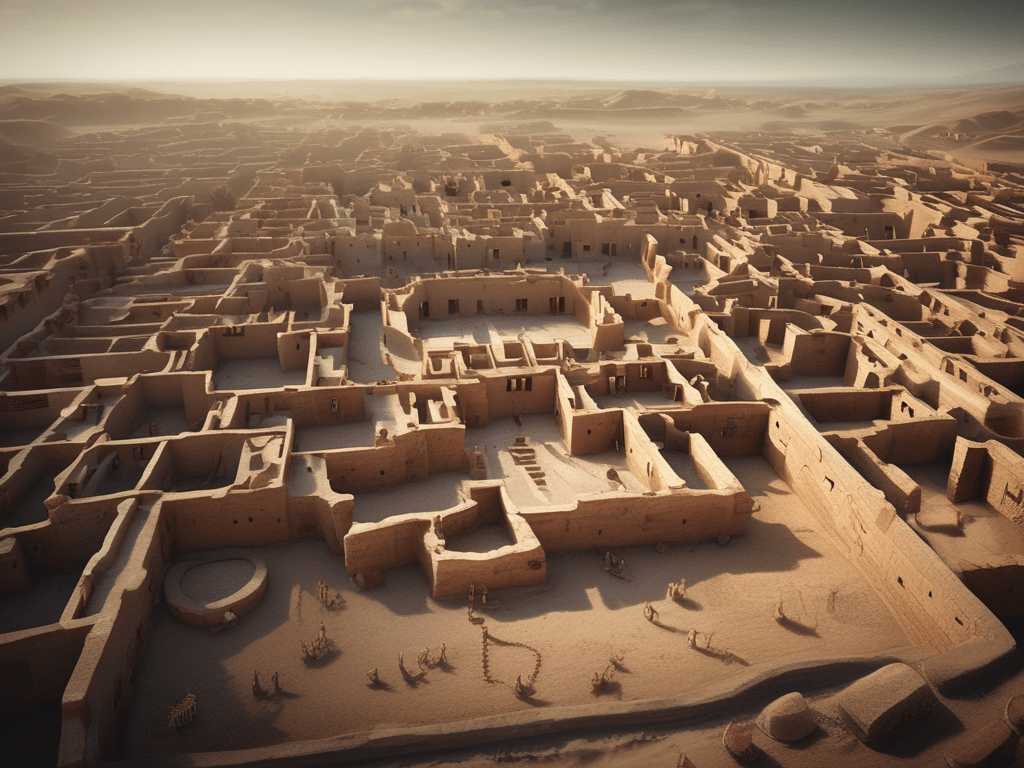
Cities were well planned with sophisticated sewage systems, public baths, and uniformly constructed houses, reflecting a society concerned with collective well-being rather than individual glorification. Evidence also suggests that trade was a central activity, connecting the 7 Rivers Civilization with other distant cultures, which encouraged a degree of open-mindedness and cross-cultural cooperation.
After 2200 BCE: The Emergence of Castes and the Rise of the Ego
Around 2200 BCE, the 7 Rivers Civilization experienced notable changes in its social structure. Archaeologists and historians associate this period with the gradual decline in the use of soma due to a strong and long drought, which led to a return of ego among the leaders and the population. This change coincides with the appearance of the first, more rigid forms of social stratification, marked by the emergence of castes, or varnas.
Society begins to divide into distinct social groups, with a clear hierarchy based on profession, birth, and power. The main varnas include the Brahmins (priests and teachers), the Râjanyas (rulers), the Vaishyas (traders and farmers) and the Shudras (labourers and wage earners). This division allows elites to consolidate their power and establish a more effective control structure.
Conclusion
The transition of the 7 Rivers Civilization before and after 2200 BCE illustrates a profound change in social dynamics and hierarchy. The role of soma in maintaining an egalitarian society before 2200 BCE is a fascinating aspect that contrasts with the emergence of caste and the ego of rulers after this period. This evolution reflects the complexity and diversity of human developments within one of the world’s first great civilizations.
 Le Rig Veda
Laisser un commentaire