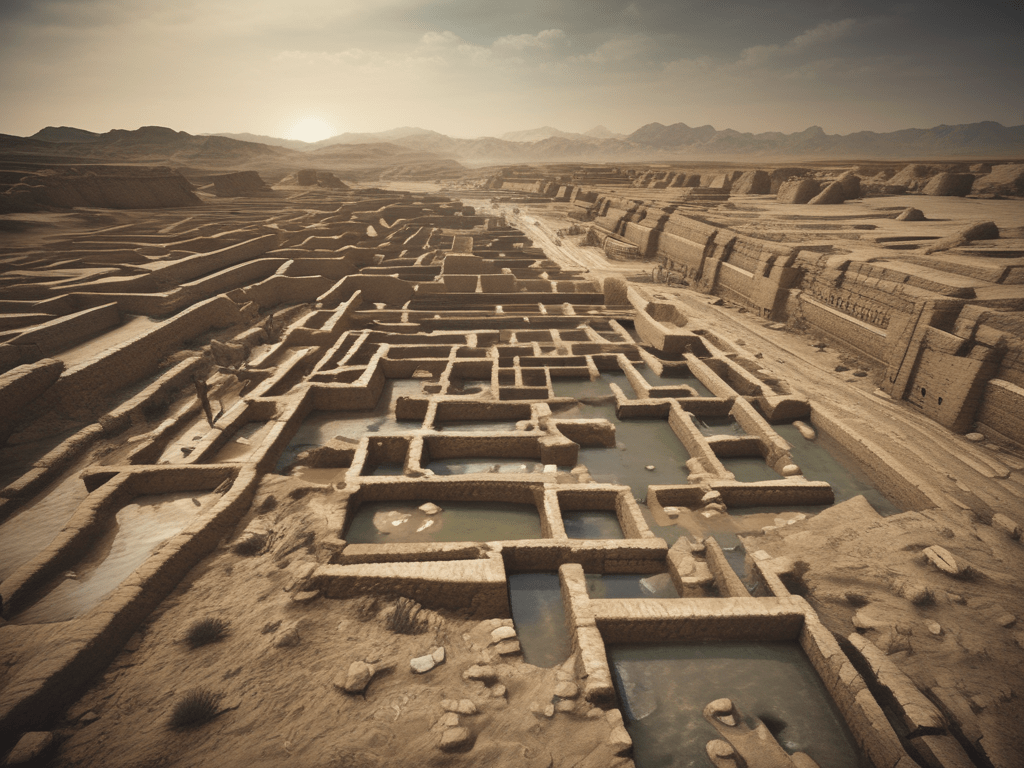
The 7 Rivers Civilization, commonly known as the Indus Civilization, is one of the oldest and most advanced Bronze Age civilizations, having flourished between 3500 and 1900 BCE in the region which currently covers Pakistan and northwest India. Perhaps one of the most impressive aspects of this civilization is its sophisticated infrastructure, particularly its sewage and water supply systems. These systems are not only proof of their ingenuity but also of their sense of hygiene and thoughtful urban planning.
Water Supply Systems
The 7 Rivers civilization was remarkably advanced when it came to water supply. Cities such as Harappa and Mohenjo-daro show clear evidence of a well-planned water system. Here are some of the main features of this system:
1. Wells and Reservoirs:
– City dwellers had access to fresh water through numerous wells, often made of brick, scattered throughout residential and public areas.
– Large reservoirs or cisterns, used for water storage, have been discovered. These reservoirs were used to collect rainwater, a precious resource in times of drought.
2. Pipelines and Aqueducts:
– Terracotta pipes were found, used to transport water from wells and reservoirs to homes and public areas.
– Some sites show the use of rudimentary aqueducts to carry water over greater distances.
3. Public and Private Baths:
– One of the most iconic structures is the Grand Bath of Mohenjo-daro, a public swimming pool that measures approximately 12 meters long, 7 meters wide, and 2.4 meters deep. This bath was probably used for religious rituals or community activities.
– Private homes often had their own bathrooms with brick drains leading to exterior sewer systems.
Sewer Systems
The wastewater management in the 7 Rivers civilization was just as impressive as their water supply. Elaborate sewage systems show a thorough understanding of the need for a clean and healthy environment.
1. Drain Network:
– The streets of large cities were lined with covered drains built of fired bricks, which were used to evacuate wastewater from homes and public buildings.
– These drains were often covered by stone slabs, allowing easy maintenance and cleaning.
2. Toilets and Flushing Systems:
– Houses were equipped with toilets, often connected directly to the sewers. These toilets had wooden seats and were cleaned regularly.
– Some remains suggest the use of rudimentary flushing systems, using water from tanks to clean toilets.
3. Solid Waste Management:
– In addition to sewers for wastewater, there were also collection wells for solid waste, which shows a concern for garbage management.
Conclusion
The sewerage and water supply systems of the 7 Rivers civilization demonstrate advanced social and urban organization, technical ingenuity, and careful attention to public health and hygiene. Their ability to design and maintain such sophisticated systems is further evidence of their preeminent place among the great civilizations of antiquity. The discovery and study of these infrastructures continue to illuminate the practices and innovations of this remarkable civilization, providing valuable lessons for modern water and waste management systems.
 Le Rig Veda
Laisser un commentaire