Introduction
The Rig Veda is one of the oldest and most revered texts in Indian literature. Dating back more than 4000 years, it constitutes an essential part of the four Vedas, the sacred texts of Hinduism. This collection of hymns is not only a source of spirituality and rituals, but also a wealth of information on the culture, society and beliefs of the Vedic era. This article explores the composition and structure of the Rig Veda in detail.
Composition of the Rig Veda
General structure
The Rig Veda is composed of 1028 hymns (or suktas), divided into ten books called Mandalas. These hymns are written in Vedic Sanskrit, an archaic form of classical Sanskrit. Each hymn consists of several verses called shlokas. In all, the Rig Veda contains approximately 10,600 verses.
### Organization of Mandalas
The ten Mandalas are not equal in size nor organized in a homogeneous manner. They can be classified into two main categories:
1. Family Mandalas (Mandala 2 to 7): These books are attributed to different families of priests and are relatively homogeneous. Each of these Mandalas is traditionally associated with a family of Rishis (sages) who composed the hymns.
2. Non-family Mandalas (Mandala 1, 8, 9 and 10): These books are more heterogeneous. For example, Mandala 1 and the significantly later Mandala 10 are the longest and contain a wide variety of subjects and styles. Mandala 9 is unique in that it is entirely dedicated to Soma, a sacred ritual drink.
Vedic Deities
The hymns of the Rig Veda invoke various deities, reflecting a rich and complex cosmology. The main deities mentioned include:
– Indra: The warrior, often celebrated for his victories over demons (Asuras). It represents strength and energy.
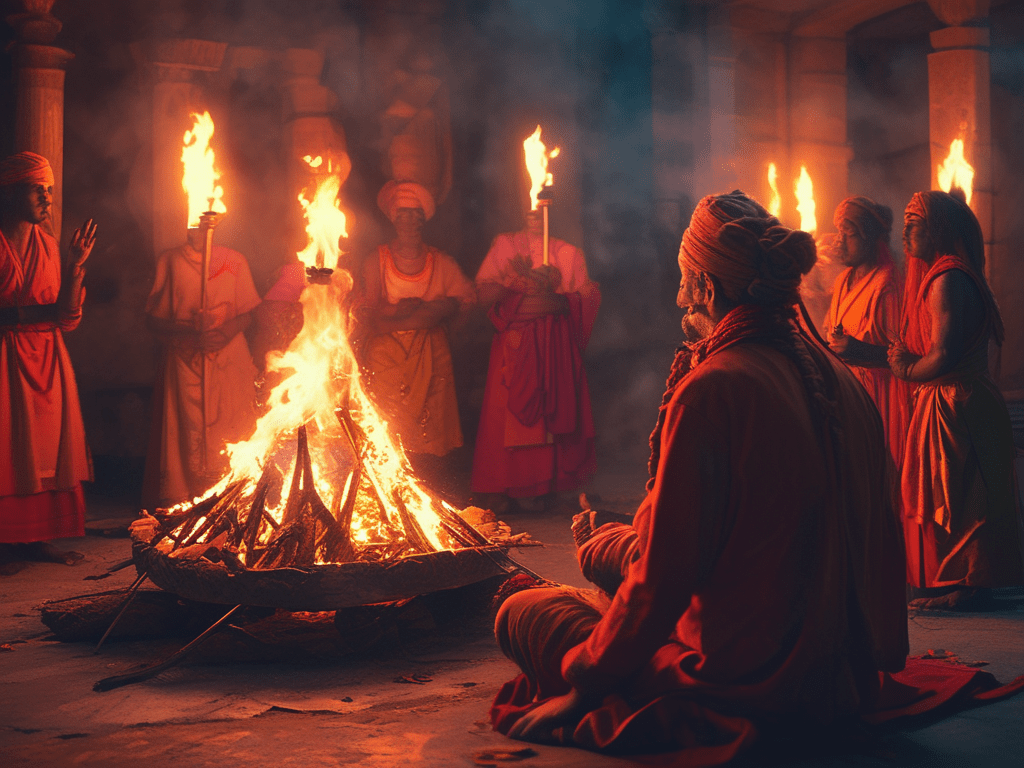
– Agni: The deified fire, essential for sacred rituals.
– Soma: Associated with the eponymous ritual drink, considered a divine elixir based on entheogenic mushroom.
– Varuna: The vastness, the deified ocean.
– Ushas: Dawn
and many others.
Structure of the Hymns
Each hymn of the Rig Veda follows a complex poetic structure. Here are some key elements:
Vedic Meters
The verses of the Rig Veda are composed in various poetic meters, called Chandas. The most common are:
– Gayatri: Composed of three verses of eight syllables each.
– Anushtubh: Composed of four verses of eight syllables each.
– Trishtubh: Composed of four verses of eleven syllables each.
– Jagati: Composed of four verses of twelve syllables each.
Language and Style
The language of the Rig Veda is rich in imagery and metaphors. Hymns often use parallelisms and repetitions to enhance their poetic and ritual impact. Additionally, hymns vary in style, ranging from devotional prayers and invocations to mythological narratives and philosophical speculations.
Significance and Influence
The Rig Veda is not just a religious text; it is also a valuable source for understanding the ancient history of India. It offers insights into:
– Social and political life: The hymns mention kings, battles and alliances, providing information on the political organization of the time.
– Ritual practices: The detailed descriptions of Vedic rituals show the importance of sacrifices and chants in religious life.
– Philosophical thought: Certain hymns, particularly in Mandalas 1 and 10, explore metaphysical and cosmogonic questions, laying the foundations for later Indian philosophy.
Conclusion
The Rig Veda, with its complex composition and elaborate structure, is a monumental work of ancient literature. It continues to influence not only religious practices in India, but also the overall understanding of Vedic civilization. His study reveals a depth of thought and cultural richness that shaped the development of Indian spirituality and philosophy.
 Le Rig Veda
Laisser un commentaire